Denmark to be Silicon Valley
The Minister for Higher Education and Science Esben Lunde Larsen (V) prefers development to phasing out and therefore the focus should be on research and growth. He expressed these views at an open meeting at AU Flakkebjerg.
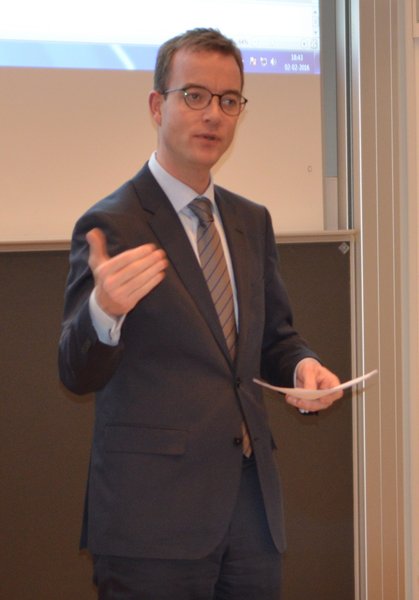
(Photos: Charlotte Hamann Knudsen)
When the Minister for Higher Education and Science Esben Lunde Larsen (V) visited AU Flakkebjerg on 2 February, 2016 he told a short story about Detroit and Silicon Valley. It was a story about development and phasing out.
Esben Lunde Larsen described how Detroit in 1960 was a thriving city and the richest in the USA. At the same time there was an area in California that was most well-known for its fruit orchards. This area, which was then called Valley of Heart’s Delight, is now known as Silicon Valley.
Since 1960 it has gone downhill for Detroit and a million people have left the city. Silicon Valley, on the other hand, has experienced rapid technological developments and a million people have moved to the area.
- Denmark must be Silicon Valley, Esben Lunde Larsen stated and gave an example that proves we can do it.
- Danish agriculture has developed significantly in my lifetime. Denmark now has one of the world’s most efficient productions and supplies food with the smallest environmental impact per kg produced product, he said. In that regard AU Flakkebjerg is an important greenhouse for germinating new seeds – not only literally but also figuratively because it is a place where research is translated into growth and jobs.
Open meeting in AU Flakkebjerg
Esben Lunde Larsen visited AU Flakkebjerg in connection with a meeting organised by the political party Venstre in Slagelse. Besides being shown around the research centre (Read the article Fascinated minister for research shown research at AU Flakkebjerg LINK), the minister was afterwards present at an open debate meeting where there were approximately 50 people and where the new agricultural package was debated, among other topics.
Also present during the minister’s visit to Flakkebjerg were Dean Niels Chr. Nielsen, Vice-Dean Kurt Nielsen, Head of Department Erik Steen Kristensen and Head of Department Erik Østergaard Jensen. Niels Chr. Nielsen held a talk that gave an overview of Aarhus University’s activities within the area of food and agricultural science, including policy support and collaboration with the industry.

In the front row are seated from the left Erik Østergaard Jensen, Erik Steen Kristensen, and Esben Lunde Larsen.

In the front row from the left are seated Kurt Nielsen, Per Kudsk, and Niels Chr. Nielsen.
Besides specialised laboratories, Aarhus University has, within the food and agricultural science area, many large and unique facilities, such as HTL pilot plant, biogas plant, animal housing, fields, greenhouses, and semi-fields in Foulum, Flakkebjerg and Aarslev. Aarhus University works in close collaboration with the industry, including Agro Business Park, Agro Food Park and Seges in addition to a range of commercial enterprises.
The dean pointed out that it is on the basis of these conditions, among others, that Aarhus University is able to deliver research-based, high quality policy support in addition to world class research that benefits Danish business and agriculture. Niels Chr. Nielsen also emphasised the importance of not making policy support competitive, exactly because it is underpinned by such an extensive research machinery.
Head of Department Erik Østergaard Jensen, Department of Molecular Biology and Genetics, told about Crop Innovation Denmark. This is a collaborative effort between universities and the industry that has enabled them to launch large research projects. An example of this is a project that was granted DKK 27 mill. in November 2015 from Innovation Fund Denmark. The project is about using advanced genetic breeding techniques to produce broad beans that are capable of competing with soya beans on price, yield and quality. The perspective is that Denmark can become self-sufficient with regard to protein feed instead of importing soya from abroad.
Danish agriculture: Sustainability and growth
Erik Østergaard Jensen’s talk was followed by one given by Erik Steen Kristensen, head of the Department of Agroecology. Erik Steen Kristensen explained the importance of the agricultural package for agriculture and the environment – an agricultural package that is built on a long series of answers, memos and other research-based knowledge supplied by the department and Aarhus University.

Erik Steen Kristensen explained the impact of the new agricultural package.
- In Denmark we have reduced our nitrogen surplus to the environment markedly in recent years but we are still on the high side. That is unsatisfactory. We need to have an agricultural production that does not impact the environment and that creates jobs, he said and continued:
- The smart thing about the new agricultural package is that farmers are now encouraged to minimise the impact per produced unit. It is much better to regulate loss of nitrogen than use of nitrogen because it is nitrogen loss that impacts the environment.
Erik Steen Kristensen highlighted the importance of legislation based on scientific knowledge. Esben Lunde Larsen agreed and said that it is unsustainable for the debate if the parties involved mistrust each other’s measurements and concrete results.