Fascinated Minister for Science shown research at AU Flakkebjerg
Knowledge, growth and how the two are connected were amply demonstrated at AU Flakkebjerg, when the Minister for Higher Education and Science Esben Lunde Larsen (V) came for a visit.
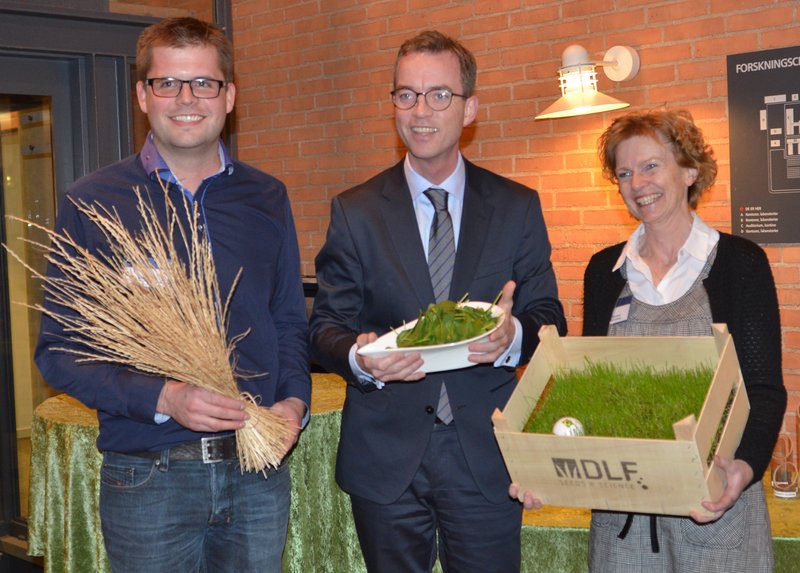
No one needed to explain the difference between barley, rye and ryegrass, when selected studies at AU Flakkebjerg were shown to the Minister for Higher Education and Science Esben Lunde Larsen (V) during his visit to the research centre on 2 February 2016. He can manage that on his own.
Born and raised on a family farm by the West Jutland town of Stauning, Esben Lunde Larsen has been surrounded by these types of crops in his youth. This certainly did not detract from his fascination with the research being carried out at AU Flakkebjerg – on the contrary. He posed a wide range of agriculturally and scientifically specific questions. He was also interested to hear that the scientists have close relations with the industry. Fruitful industrial collaboration goes well with Esben Lunde Larsen’s desire for ”knowledge, growth and value in the whole country”, as he wrote about in an article in Denmark’s largest daily newspaper Jyllands-Posten on 14 January 2016.
Collaboration with the industry is also important to Innovation Fund Denmark, which supports several of the research projects that were presented, and which makes it obvious that money granted from the fund to Aarhus University is money well spent.
It is difficult not to be enthusiastic when you hear about all the exciting research projects that the scientists at AU Flakkebjerg are involved in and are carrying out in close collaboration with the industry. It appeared that the science minister Esben Lunde Larsen felt the same way. The fact that his father grew ryegrass probably helped pique his interest.
The Department of Agroecology and the Department of Molecular Biology and Genetics both carry out research at AU Flakkebjerg. What they have in common is plant science, but otherwise it was an exciting potpourri of selected research projects that were presented in a committed and easily understandable manner to the minister by the two departments’ professors, senior scientists, postdocs and PhD students. Sample some of the research in the following:
A helping hand to the world’s wheat
Wheat is the world’s most important crop but is under threat from fungal diseases. It is necessary to develop wheat varieties that are resistant to a range of fungi to secure food for millions of people and to avoid overuse of pesticides. The Global Rust Reference Center at AU Flakkebjerg plays a central role in these efforts. (Read the articles Invasions out of centre of diversity increase the risk of disease epidemics in wheat and The Global Rust Reference Center has improved the early warning of yellow rust in cereals by means of DNA genotyping.)

How does resistance to pesticides develop?
Limits on which pesticides are permitted for agricultural use can very easily lead to increased resistance to the pesticides that are permitted. The problem is particularly great in weeds and fungi. Denmark has especially restrictive regulations with the aim of protecting our groundwater. In order to prevent development of resistant weeds, fungi and insects it is necessary to understand which mechanisms lie behind development of resistance. (Read the article Resistance in insects, weeds and fungi goes under the magnifying glass.

Plastic from plants
It has proven possible to create plastic from plants by designing starch molecules in crops. The starch molecules can be used to produce plastic that is sustainable to produce, biologically degradable and strong. To top it off, the starch is digestible and since it metabolises to sugar slowly there can also be health-beneficial perspectives. (Read the article Plastic fantastic from plants)

Cereal competitiveness against weeds to be sharpened
Weeds cost crop yield. Globally the loss of potential yield is estimated to be 34 per cent. One tool against weeds is spraying with herbicides but this practice can lead to resistant weeds and pollution of the aquatic environment. Cereals can to a certain extent out-compete weeds and it is this ability that scientists want to take advantage of. They are presently developing a special method to measure plant development throughout the growing season without damaging the plant.

Denmark is a grass and spinach world leader
Next time you see a world championship in football you can think about Danish farmers with pride. Denmark is the world’s largest exporter of grass seed. Grass from Danish seeds is also used for golf courses, grass skiing and pastures all over the world. Another export success is spinach seed, where Denmark produces 70 per cent of the global production. Such extensive productions require that the seeds are particularly good. The industry therefore collaborates closely with AU Flakkebjerg where the scientists investigate, for example, grass nitrogen utilisation, weed control in grass, and minimising diseases in spinach in addition to consulting breeders.

See more detailed descriptions of the studies that were presented and the programme for the minister’s visit to AU Flakkebjerg here.
You can also read the article Denmark should be Silicon Valley.