From roots to resistance
With a total 17 presentations from AGRO’s six research sections, the focus was on science on the first day of the annual senior VIP meeting in Foulum.
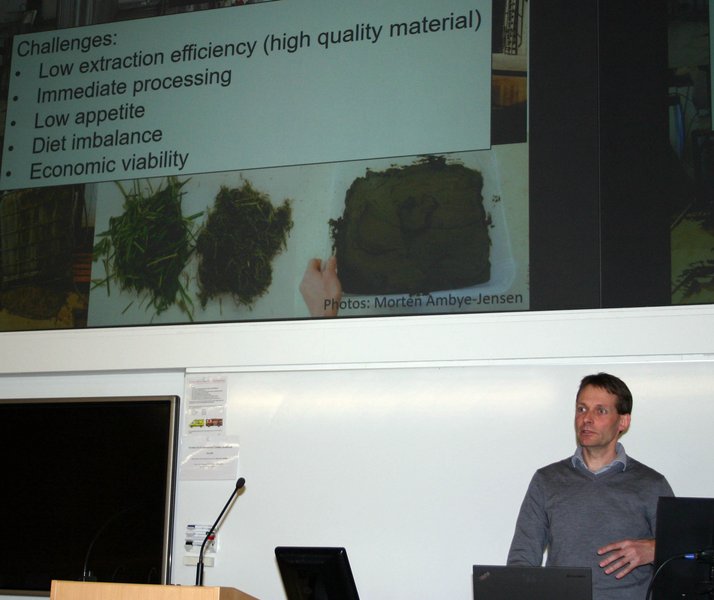
During the first part of the senior VIP meeting in Foulum on November 8-9, 2017, there was plenty of opportunity to learn more and get smarter about areas outside your normal comfort zone. A total 17 presentations shed light on topics ranging from events that play out in the root zone to the travels across borders taken by tiny fungal spores that can have a huge impact on global wheat harvests, and from soil erosion to nutrient emission.
Questions such as ”Can we learn from other countries’ experience with environmental measures?”, ”Do Danish fields emit as much nitrous oxide as we think?” and ”Is the assumption that it costs organisms to develop resistance to pesticides correct?” were answered. A hint: The answers to these three questions was mainly ”no”.
Questions with a greater probability of being answered with a ”yes” were for example ”Can a mixture of grass, clover and flowers be converted to protein and also provide food for bees and other pollinators?” and ”Can a model for more timely treatment against potato blight be constructed?”.
In some cases, there were examples of how work in one project can be used in other projects and in policy support tasks. For example, a current project regarding mapping, use and visualisation of site-specific data can make it easier to use data about land use, soil quality, fertilisation, climate and drainage.
You can view the slides from the presentations on the O-drive at the address O:\ST_AGRO\Stab\SeniorVIP2017.