(Bio) diversity and good agricultural practice
Agriculture has a decisive influence on biodiversity - both in Denmark and globally. Therefore, in recent years there is a greater and greater focus on solutions to both increase and protect the biodiversity of the agricultural landscape; also because there is a close connection to the other urgent global crises around climate, nitrogen, sustainable land use, etc. In that arena, our knowledge from the Department of Agroecology really comes into play, and includes a focus on both more biodiversity and diversity in general, as a part of good agricultural practice in an increasingly changing world.
On 25 October, we had a visit from the IPBES Steering Committee; “Intergovernmental science-policy Platform on Biodiversity and Ecosystem Services” by the Danish coordinator Lars Dinesen from the University of Copenhagen, and Anders Sanchez Barfod from the AU Department of Biology. Among other things, they talked about how we from AGRO and the other TECH institutes have the opportunity to contribute via established expert groups, just as ECOSCIENCE already does through their representative Beate Strandberg.
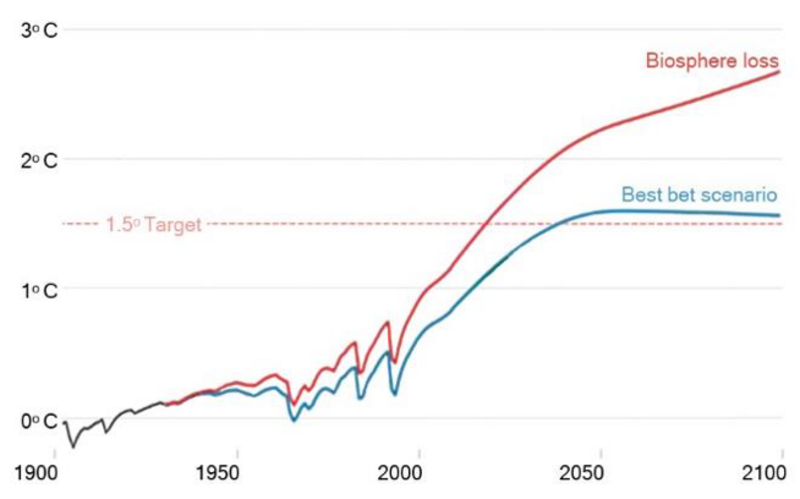
IPBES is a parallel to the IPCC in the field of climate, and just as the IPCC works to advise governments and other decision-makers with research-based knowledge about climate change and its mitigation, IPBES similarly covers the field of biodiversity. And interestingly enough, the latest research shows how the two areas are closely linked, as a lack of protection of the world's biodiversity, and thus the biosphere, will mean critically increased climate change; even in a “best bet” scenario that will live up to the desired max +1.5 degree climate normal (Figure 1).
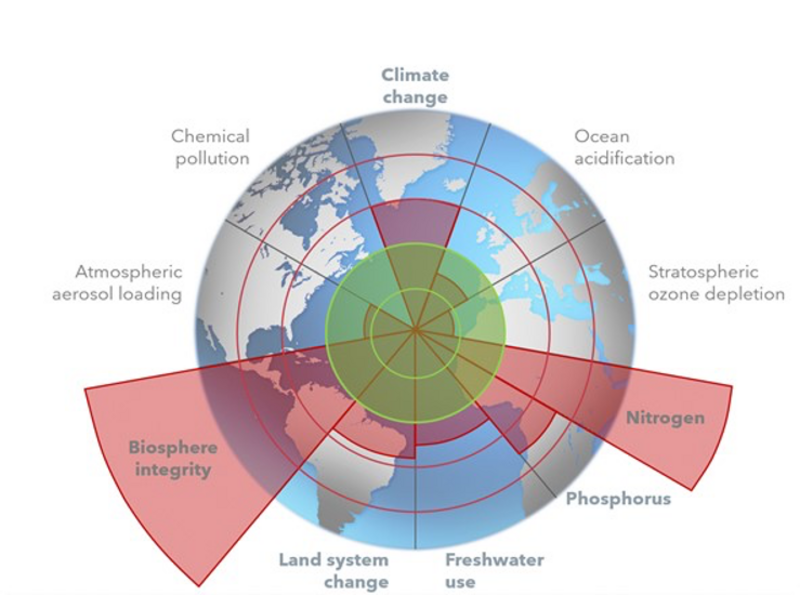
Precisely such contexts, and how the development of agriculture in Denmark as well as internationally can be an important part of the solution for a sustainable future development, are thus absolutely central to our research here at the Department of Agroecology. And many of the solutions must be found completely locally, as we will do in the next 5-6 years in a number of study landscapes associated with the new Sustainscapes.org center, where 30 primarily young AU researchers across agroecology and biology have just been gathered for a kick -off meeting. There is a need for very comprehensive knowledge and solutions that can go across the research fields, and thus contribute to the solution of the contemporary crises we see, both in the field of biodiversity and climate, but certainly also in terms of nutrients and water, and land use in general. (Figure 2).
The development of this field of research will be both an exciting and important area for the coming many years, and it is important that the local solutions are linked to global effects; a concept that in the context of landscape research and in relation to the UN’s Sustainable Development Goals (SDG) is often called telecoupling, and where we also in the Life Cycle Assessment (LCA) context work with effects of indirect land use changes (iLUC).
In conclusion, I would like to emphasize the importance of this globally connected world not just leading to single-track, locally specialized production systems. This is not only because a multifaceted bouquet of solutions is needed in response to the multifaceted but coupled solutions the world is facing (Figures 1, 2), but also because we are facing a world of expected, ever-larger, and often sudden changes (just think of the Covdi-19 pandemic, the great climate extremes seen around the world, or how world trade can be affected by a single large ship across the Suez Canal!). Holistic, broad-spectrum solutions that are resilient to such changes should therefore be a significant area of attention for our research, as well as for the agricultural practices that develop over the coming years. The EU's new agricultural policy, and the corresponding newly adopted, new Danish agricultural package, which we are just concluding the strategic environmental assessment of, provide a good margin for this. This is a long story that we will definitely return to in the years of research and research-based government efforts and teaching.