Decades of collaborative research comes to an end
Building Stronger Universities (BSU) III International Closing Conference Gathers a Decade of Ghana-Denmark Collaborative Research Projects


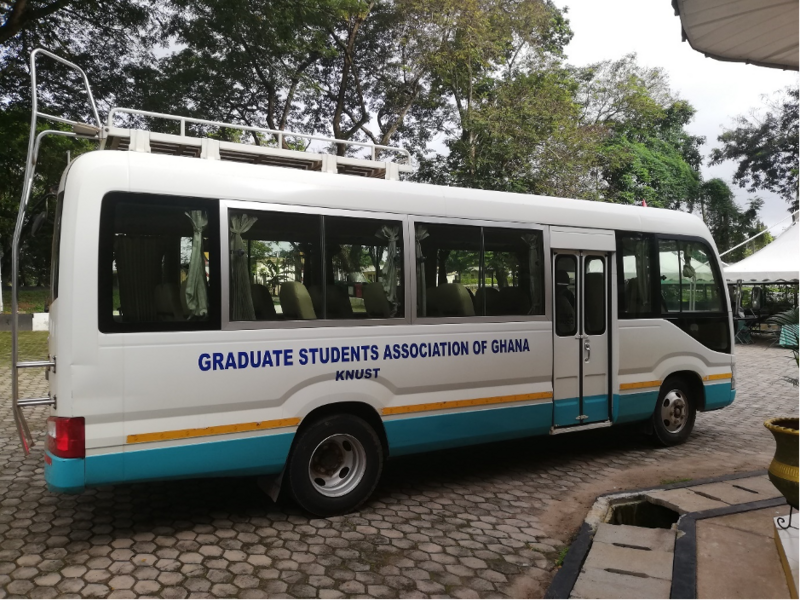
The Building Stronger Universities (BSU) programme funded by the Danish International Development Agency (Danida) was established in 2011 as collaboration between all Danish universities and 11 higher education institutions in five countries of the Global South - Tanzania, Ghana, Uganda, Kenya, and Nepal. The programme aims to strengthen research capacity in areas of PhD curricula, research methods and infrastructure, as well as research support and administration. The programme rests on four main science pillars:
- climate change adaptation,
- enhancing food production and processing,
- malaria research,
- development policy,
- poverty monitoring and evaluation.
It runs in three phases, with 1 and 2 being driven by the Danish partners and focusing primarily on individual capacity development through scholarships and gradual transition to self-administered programme (phase 3) and actions to better reflect the need for institutional capacity development.
The Department of Agroecology (AGRO) has since 2015 been the coordinating partner of BSU 3 activities with the University of Ghana (UG) and the Kwame Nkrumah University of Science and Technology (KNUST), the two leading Ghanaian universities. The projects are coordinated, for the Danish part, by AGRO’s senior researcher Finn Plauborg (for UG) and research adviser Torsten Rødel Berg (for KNUST). However, as conventional development cooperation between Denmark and Ghana has come to an end, so will the Danida funding for development research in Ghana and BSU end in 2023, with on-going joint research projects gradually ceasing in the coming three-four years. For that reason and to synthetize achievements and perspectives, a final international scientific conference was conducted at KNUST on 4-5 October 2022 under the auspices of BSU.
Alongside the BSU projects, the past decades have seen a broad array of collaborative Danish - Ghanaian research projects from the Consultative Research Committee on Development Research (FFU). Reflecting natural resource management as focus of the majority of these projects, and with a view to explore avenues for future collaboration, the conference, under the theme “Climate Change Resilience, Adaptation and Sustainable Rural Transformation” gathered a wide range of Danida supported research projects in Ghana, many of which have AGRO involvement.
Harvesting the fruits of a decade of research capacity collaboration
Ghana encounters significant challenges due to climate change such as increased variability and duration of extreme weather events (heatwaves, droughts, floods, wildfires), hampered rural development and inadequate investments. The international conference presented a range of research-based solutions to these challenges that affect food production, health, and livelihoods, as well as novel methods and approaches to strengthen climate change adaptation and rural resilience. AGRO researcher Kiril Manevski has been part of BSU since 2015. As part of the scientific committee of the conference, he evaluated more than 50 abstracts, mainly from Ghana, and fewer from the wider West-Africa region. He finds the conference and its organization a success, observing that:
“There was a clear pattern of high-quality contributions with clear relevance to Ghana such as crop nutrition and irrigation management (design, scheduling, soil amendments for moisture retention, including mulch and especially biochar), drought detection though field experimentation and remote sensing, high-value crops production (cocoa bean), as well as socio-economic studies”.
Torsten Rødel Berg, coordinator of the BSU project with KNUST, also attended the event and agrees with Kiril Manevski on the success of the conference, adding:
“KNUST provided a good balance between highly dynamic oral and poster presentations and relevant keynote talks on directions in research, overviews of climate related challenges in Ghana, how KNUST research addresses these, as well as the impacts of climate change on health”. Torsten Rødel Berg is particularly pleased with the plans for a special issue of selected contributions to be published in the Elsevier’ Scientific African journal, as announced by Prof. Robert Abaidoo, the KNUST coordinator of BSU, towards the end of the conference. This, he says, “is a clear indication of effective research collaboration and high-quality research outputs”.
A significant number of presentations could be traced back to Prof. Mathias Neumann Andersen and his decadal involvement in crop production and irrigation FFU research projects with Ghanaian partners at UG and also the University of Cape Coast. He says: ‘We have focused on climate-smart agriculture, agricultural resilience and resource management, we have unveiled research approaches, designed field- and modelling tools, delivered equipment and disseminated knowledge on crop, soil and water management, thereby revealing avenues to increase productivity per unit of land under limited resources in small-holder agriculture, which is the typical mode of production in Ghana. It is good to see many of my research partners now pursue advanced research careers and have set up private companies’.
Many of the presentations at the conference reflected ‘development’ as synonymous for climate change adaptation and resilience alongside productivity increase and environmental protection, rather than targeting a sole criterion. The keynote presentation by Dr. Daniel Tutu Benefoh, Ghana’s representative to the United Nations Framework Convention on Climate Change, clearly highlighted this “development shift”, as did the overview of KNUST’s research endeavors provided by Prof. Philip Antwi-Agyei. Moreover, the research projects have become more interdisciplinary, addressing the complex web of environmental, health and livelihood issues associated with climate change. Illustrating this, an overriding catchment theme has characterized BSU at KNUST and pilot studies have focused on integrated agro-hydro-ecological management of the Owabi catchment in the Ashanti region of Ghana for chemical and biological status of the reservoir, the effects of human disturbance such as land use/land cover change on ecosystem services and plant diversity dynamics.
Post-BSU prospects
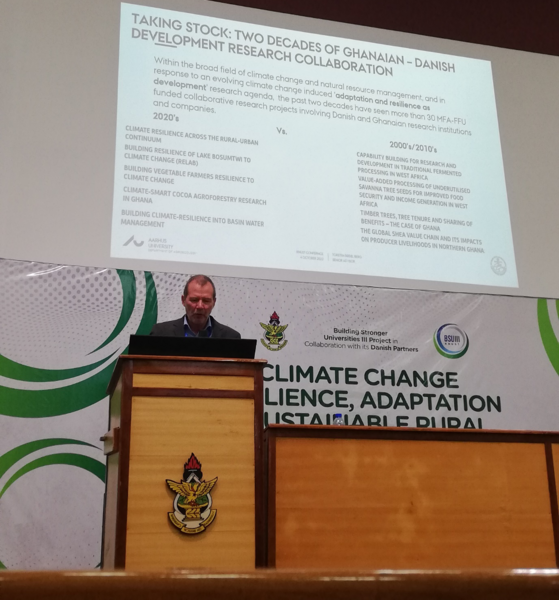
With Danish development aid to Ghana ceasing, development research activities will also end. Taking stock of achievement, the conference noted that within the broad field of climate change and natural resource management, the past two decades have seen more than 30 collaborative research projects involving Danish and Ghanaian research institutions and companies funded by the Danish Ministry of Foreign Affairs. AGRO has participated in a significant share of these projects and continues to be involved in vegetable farming and cocoa agroforestry projects. The BSU phases anchored at KNUST and UG have undoubtfully reinforced the administrative and research capacity dimension and have also generated interdisciplinary research outputs through jointly supervised PhD and pilot research projects.
However, as Finn Plauborg points out, “other funding bodies should now be targeted in order to continue research in Ghana, such as the Horizon Europe calls involving Africa. This is of particular interest and has huge potential for us in AGRO”.
Indeed, Horizon Europe in its implementation of the African Union- European Union Partnership on Food and Nutrition Security and Sustainable Agriculture (FNSSA), has its eyes firmly set on research in support of agroecology transition in Africa. The Danish-Ghanaian collaborative research efforts to date constitute a useful point of departure for contributing to this transition.