Big interest in small molecules
A hands-on PhD course at Flakkebjerg in the analysis of small molecules using chromatography and mass spectrometry is a hit with PhD students.
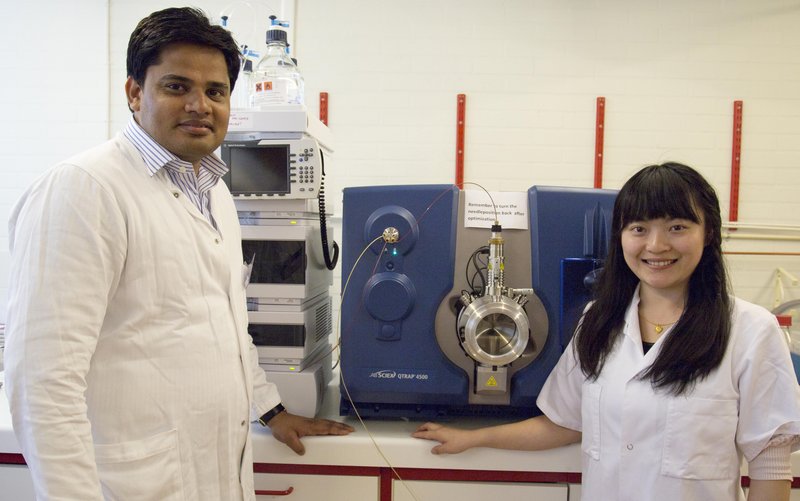
They are very small but can have a large influence: the various molecules that are present in soil, plants and animals. The challenge is to locate them and to understand them. This is what a PhD course run by associate professor Inge S. Fomsgaard is trying to do. The course is so popular that the Charles Stuart University in Australia has for several years running sent students to Denmark to follow the course. This year is no exception.
PhD student Sajid Latif, originally from Pakistan but now in Australia, has come all this way to learn how to use the advanced analytical gadgets, of which there are six in various shapes and sizes in the laboratories in Flakkebjerg.
- We learn to use the equipment to identify and quantify the components in the material from soil, plants and animals, amongst other things. These are tiny organic molecules, he explains, but he is interrupted by a keen fellow course participant, Lin Shi.
- ... the organic molecules can be important as markers or in the prevention or treatment of diseases, or they can be pathogens or components of pollutants or secondary metabolites or potential pesticides, lists Lin Shi, who originally comes from China, but is currently doing a PhD at the Swedish University of Agricultural Sciences.
The two enthusiastic students have taken 12 days out of their calendar to follow the course on “Hands-on liquid chromatography – mass spectrometry course in the analysis of small molecules” from 6 to 17 June 2016. The course is fully booked, numbering a total of 10 people, who are each getting a lot of hands-on experience at the machines in addition to learning how to first prepare samples and then to subsequently analyse the results. In addition to the two weeks of the course in Denmark, they also have to spend time preparing for the course and have to write two reports after completing the course.
- We learn about both principles and practice. Working with the machines is very important. It’s also great that the course is so interactive, says Sajid Latif. Lin Shi nods her agreement and adds:
- I will no doubt get a lot of benefit from this course, she says.
The course participants hail both from abroad, from different universities in Denmark and different departments at Aarhus University. Having such a wide and diverse group of people has advantages.
- One of the good things about the course is that we are all so different. Our PhD studies are all about different things, but even though we work on a wide range of projects we have common interests. We learn both from the teachers and from each other, say Lin Shi and Sajid Latif unanimously.
The course teachers are, besides Inge S. Fomsgaard, lab technicians, postdocs and PhD students from Flakkebjerg and specialists in mass spectrometry and chromatography from, respectively, University of Southern Denmark and University of Copenhagen, and the suppliers of Sciex and Phenomenex.