Sustainable intensification and AGRO’s self-understanding debated
Is the concept sustainable intensification the glue that binds AGRO together – or merely a worn buzzword?
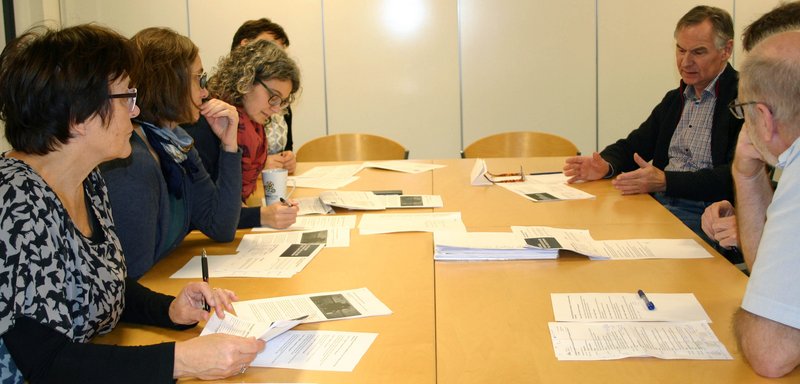
In the second part of the senior VIP meeting in Foulum on November 8-9, 2017, only senior VIP participated. During this part of the meeting, topics of common interest were on the agenda. The most comprehensive item on the agenda was a debate about sustainable intensification that was set in motion by a talk given by AGRO’s international coordinator Torsten Rødel Berg. (You can read his article ”AGRO and the concept sustainable intensification” and view the slides from his talk on the O-drive at the address O:\ST_AGRO\Stab\SeniorVIP2017.)
Torsten mentioned in his talk that sustainable intensification ties AGRO’s research together not least in relation to research in digital technology (e.g. precision agriculture and intelligent solutions), UN’s goals for sustainable development, and the narrative about feeding nine billion people in 2050. These topics are important ingredients in the Danish agricultural research strategies which set the framework for AGRO’s research under the motto ”more for less”.
There was already a lively debate during the presentation. One consideration from the participants was that sustainable intensification’s productivity aims associated with feeding nine billion people is not comprehensive enough, and that focus should instead be on the UN’s sustainable development goals. In particular, goal no. 2 (”zero hunger”) is highly relevant. The aim here is to not only supply calories but also to ensure proper nutrition to all and to generate reasonable incomes while protecting the environment, and supporting rural development in which people are central.
Linked to a broader focus, participants in the meeting also found that there is a difference between ”sustainable agriculture” and ”sustainable food supply” and that perhaps we should expand our concepts to the latter.
Another consideration was that sustainable intensification does not necessarily stem from improved utilisation of continually increasing input. Sustainable food security can also be approached by working from other angles, such as reducing food waste and improving food distribution.
It was also pointed out that it is important to not only work with input and output but also consider limitations, e.g. the aim of keeping global warming under 2°C and the maximum limits for nutrient emissions.
Following the talk and debate there was group work, during which four questions based on Torsten’s presentation were discussed. Each question was treated from each flagship’s perspective but across sections. In brief, the conclusions were as follows:
Sustainable Nutrient Management – General environmental measures, such as catch crops, maintain nutrients within the farm while targeted measures, such as mini-wetlands, minimise emission to the aquatic environment but result in nutrients being lost from the farm. We should therefore differentiate between whether the system is sustainable in relation to the aquatic environment or in relation to agriculture. With regard to research, we must generate more knowledge about the processes in the field and about making the measures more efficient.
Soil Functions – Sustainable intensification is not merely a question of ”more for less”, i.e. more production on the same area, but is also a question of creating more value. Technology plays a major role in sustainable intensification. In connection with targeted regulation and an increased focus on mechanical weed management, we must generate more knowledge about the soil’s variations, including its structure, quality and texture, and soil compaction and erosion risks. Besides charting the variations, we must also transform the knowledge we generate to applicable solutions, e.g. by developing decision support systems that can help farmers decide when, where and how to drive on the soil.
Climate-Smart Agri-Food Systems – Some systems are good in some areas but shift problems over to other areas. One example is mini-wetlands. They prevent nutrient emissions to the aquatic environment but remove important nutrients from the soil. Another example is organic pig production, where the pigs risk being fed below their optimum, resulting in a greater climate and environmental footprint per kg meat produced. Our research must therefore concentrate on whole systems (e.g. production of grass for feed, protein, fertiliser and other bio-based products), and hone the existing systems so they become more sustainable.
Sustainable Pest Management – In AGRO we share the common understanding that agricultural food production is right and connected with optimal resource utilisation, while other people may have a completely different outlook on agriculture. For example, we may see a field and think “Here is a hectare that can produce food,” while a biologist might think that ”a hectare tilled soil is a hectare lost nature.” It is important that we maintain our common understanding in the department. Another point from the group was that the premises for discussing sustainable intensification are different in a country such as Denmark, with a modern, highly efficient and highly productive production, than in other countries where production takes place under completely different conditions. The same solutions do not fit all. We must also look at how we measure sustainability. Without clear parameters we cannot see if we are moving in the right direction.
AGRO, sustainability and the future: The next steps
- Sustainable intensification covers the work we carry out in AGRO quite well, suggested Erik Steen Kristensen in his concluding remarks after the participants had debated the concept. The discussion in AGRO about sustainable intensification does not end with the senior VIP meeting, though. We should continue to discuss and reflect on this research-framing concept.
- We should continue the discussion about sustainable intensification and carry out research in how to make new systems sustainable, said Erik Steen Kristensen. Both he and others at the meeting pointed out that it is important to make things more concrete in order for us to take this a step further.
- We must quantify and operationalise the discussion about agroecology and sustainable intensification so that we can apply the concepts in more operational terms in our daily work, Erik said. Some action has already been taken in FACCE-JPI. Torsten Rødel Berg is in a group that is working on quantifying the concept sustainable intensification. The plan is to start by identifying suitable sustainable identification indicators in the various EU countries. Torsten expects to involve some of AGRO’s researchers in this work when the time comes.
Another aspect that was mentioned at the senior VIP meeting and that Erik Steen Kristensen would like AGRO to consider is how to better align research with the UN’s 17 Sustainable Development Goals.