Texture determination: Possibility for following international practice
From now on the Analysis Unit in AGRO can offer a method of determining soil texture that is an alternative to the regular Danish way but on par with international practice. Wonder and surprise in a PhD student led to this new option.
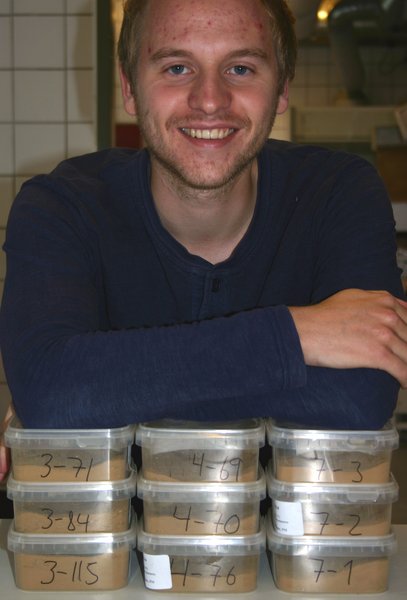
Wonder and stubbornness in PhD student Johannes Jensen, JORD, has led to an additional option for requesting soil texture analysis from AGRO’s Analysis Unit. If the new type of texture analysis is used then our data can more easily be compared with data from other countries. However, the method is not in tune with the official Danish method, which is the basis for the Danish soil classification system.
This spring, Johannes Jensen took soil samples in a long-term field trial at Rothamsted Research in connection with his PhD studies with Lars J. Munkholm in JORD. The samples were analysed at the Analysis Unit in AGRO using the official Danish method which is in accordance with the Danish Agrifish Agency. However, there was something about the data that set Johannes Jensen to wondering.
- I puzzled over my data because the clay content fell with increasing carbon content while the silt content increased with increasing carbon content for the soils with less than three per cent carbon. On the other hand, the soils containing more than three per cent carbon had a clay and silt content on the same level as soils with a low carbon content, explains Johannes Jensen.
In AGRO we use the method that the Danish Agrifish Agency refers to while internationally another method is usually used. The difference between the two methods of analysis lies in how the organic material in the soil samples is treated.
In Denmark the laboratory first determines the soil’s content of organic material measured as carbon content. If the carbon content is equal to or less than three per cent then the soil texture is determined without further ado. However, if the carbon content is more than three per cent then the organic material is removed by oxidising the sample with hydrogen peroxide before the soil sample’s texture is determined.
This is where we in Denmark differ from international practice. In international analysis regulations the organic material is removed from the soil samples prior to the texture analysis no matter what the carbon content. The process of removing the organic material before determining texture consumes time and labour. Therefore, the Danish practice is to remove the organic material only is some cases. The presumption is that removal of organic material before texture determination does not affect the result very much in soils with a carbon content equal to or less than three per cent. This is where we go wrong.
- It is said that it does not matter much if the organic material is removed prior to further analysis of soil samples with a low carbon content. But is does matter. I saw this quite clearly in my data, Johannes Jensen points out.
It is a problem if our results do not reflect reality or cannot be compared with those from other countries. Therefore, AGRO’s Analysis Unit now offers a choice between the two types of analysis – the Danish one in which the organic material is only removed if the soil contains more than three per cent carbon, and the international one, in which the organic material is removed independent of the soil’s carbon content.
- From now on I will request that the organic material is removed prior to all my texture analyses. It is very important for me that the soil’s texture is determined as precisely as possible because I work with the effect of the relation between the soil’s content of small mineral particles (