Two worlds meet about common challenges within precision agriculture and smart farming
Two years of collaboration between AGRO and Innovation Centre Denmark in Sao Paulo culminated in a workshop in Brazil, where one third of the participants came from AGRO. The workshop paved the way for new collaborative possibilities within sustainable intensification.
Brazil has a tropical climate while Denmark has a temperate climate. The two countries also differ with regard to farm size and socioeconomic conditions, but despite big differences between Danish and Brazilian agriculture, there are common challenges regarding adaptation of technologies to user needs and data treatment. Research collaboration between the two countries is therefore a good idea – and we already carry it out via active Danish- Brazilian collaboration.
The latest result of two years of collaboration between Aarhus University and Innovation Centre Denmark in Sao Paulo was the workshop ’Sustainable Intensification through Precision Agriculture and Smart Farming’, which was held October 25-26, 2017 at the University of Sao Paulo's Luiz de Queiroz College of Agriculture (USP-ESALQ). The workshop shed light on, among other things, the challenges regarding sensor technology, data collection and production, fertilisation, pesticides and soil tillage.
Matchmaking was on the agenda on the second day of the workshop. Here the parties identified common research interests and wrote them down in concept memos for use in common research applications.
AGRO strongly represented
The nine Danish delegates came mostly from the research project Future Cropping. The participants from Aarhus University were René Gislum, Lars Juhl Munkholm and Torsten Rødel Berg from AGRO and Claus Aage Grøn Sørensen from ENG. They were responsible for the scientific planning in collaboration with USP-ESALQ.
In addition, there were representatives from the University of Copenhagen, Seges, the commercial company Geoteam, and Innovation Centre Denmark. The latter was responsible for funding and logistics. From the Brazilian side, besides USP-ESALQ, the participants included people from the Brazilian governmental sector research institution Emprapa (Brazilian Agricultural Research Corporation), other relevant departments and sections of USP, and several commercial companies.
Besides funding and logistics, Innovation Centre Denmark was also responsible for an information meeting, Innovation Attaché Stina Nordsborg enlightened the Danish delegates about the Brazilian research and education landscape as well as the political and financial context, all of which provided us with useful insights.
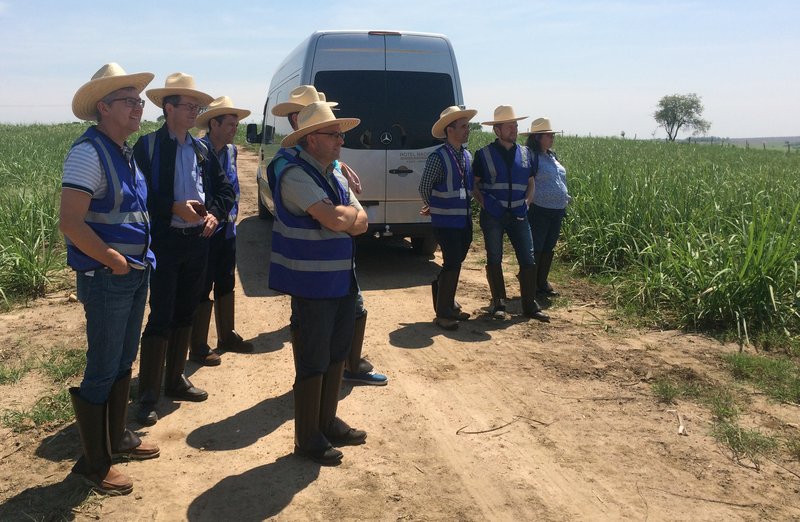
In addition to the workshop, there were visits to Emprapa Instrumentation, and Raizen, which is Brazil’s third largest producer of fuel based on sugar cane. Both visits included demonstrations, visits in the field, and good discussions.
The collaboration continues
Looking ahead, the anchors at AGRO and USP-ESALQ will strive to keep the Danish-Brazilian network that was the result of the workshop informed about future common applications and provide assistance in writing them.
Since 2011, when the department heads visited a range of research institutions in Brazil, AU’s agricultural research has experienced increasing collaboration with regard to research and education, facilitated by Innovation Centre Denmark in Sao Paulo. In addition to the newly established precision agriculture network, AGRO maintains an agroecology network with the federal university in Sao Carlos.
You are welcome to contact Torsten Rødel Berg for more information about the possibilities for collaboration with Brazil.