
AGRO: Career site
Welcome to your academic journey at Aarhus University.
This page gives you a quick overview of the typical academic career path, from PhD to Professor. It helps you understand how the roles build on each other, what kind of focus each stage has, and where you might be heading next.
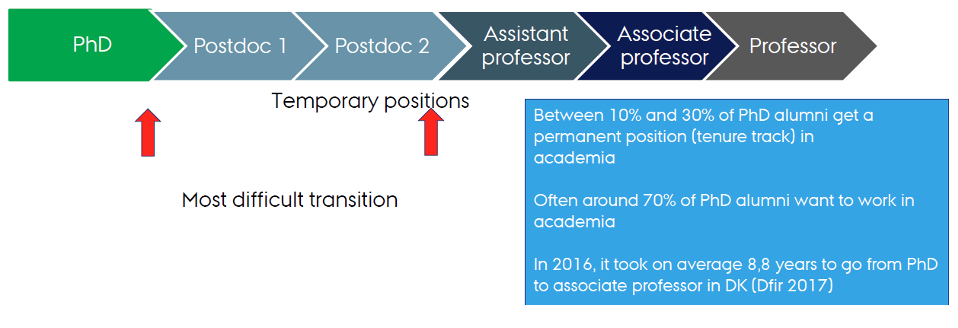
Below you can explore key themes that support your development as a postdoc, including career paths, role expectations, timelines, international opportunities, collaboration, and alignment with your manager.
🧭 Career Path Overview
🧭 Career Path Overview
Each step has its own expectations, responsibilities, and opportunities. Below, you can explore what each role typically involves and how it fits into your long-term career development.
🎓 PhD Student
🎓 PhD Student
- Focus: Independent research with supervision
- Goal: Develop research skills, publish early work, start a network, complete a PhD thesis
- Duration: Typically 3 years (full time)
This is where your research career begins. A time to explore your field and build your foundation.
🧪 Postdoc
🧪 Postdoc
- Focus: Deepen your research profile, publish high-quality work
- Goal: Gain international experience, develop independence, create a network, show that you can collaborate with others
- Duration: Max 4 years at AU (combined across contracts)
A transitional phase where you grow as an independent researcher and prepare for the next step.
🧑🏫 Assistant Professor
🧑🏫 Assistant Professor
- Focus: Start building your own research group, gain teaching experience
- Goal: Secure funding, demonstrate leadership potential
- Duration: Typically 3–6 years
You’re expected to show potential for becoming a permanent academic staff member.
🌱 Tenure Track Assistant Professor
🌱 Tenure Track Assistant Professor
- Focus: Develop an independent research profile, build teaching experience
- Goal: Meet clear criteria for promotion to Associate Professor
- Duration: Typically 6 years
- Assessment: Midway evaluation + final tenure assessment
This is a structured career path with mentoring and support, designed to lead to a permanent Associate Professor position if expectations are met.
What’s different from a regular Assistant Professor?
While both roles may have similar day-to-day tasks, the tenure track position includes:
- A formal development plan
- Regular evaluations and feedback
- Clear performance expectations for promotion
🎯 Associate Professor
🎯 Associate Professor
- Focus: Lead research projects, supervise PhD students, contribute to university strategy
- Goal: Build a strong academic profile nationally and internationally
- Duration: Permanent position (tenured)
At this stage, you’re a key contributor to your field and your department.
🧠 Professor
🧠 Professor
- Focus: Strategic leadership, research excellence, mentorship
- Goal: Shape the research environment, influence policy and direction
- Duration: Permanent position
A leadership role in research, teaching, and academic citizenship.
📍 Need Support?
📍 Need Support?
- Not sure where you are on the path or what’s next?
- Talk to your supervisor or reach out to your section manager
📋 Role Expectations
📋 Role Expectations
📋 Role Expectations
What does each academic position involve?
As you progress through your academic career at Aarhus University, expectations shift — from learning and contributing to leading and mentoring. This page gives you a quick overview of what’s typically expected at each stage.
You can use this to:
- Reflect on your current focus and future goals
- Prepare for development dialogues
- Understand what’s needed for promotion
🎓 PhD Student
🎓 PhD Student
- Develop research skills under supervision
- Deliver an original and high-quality PhD thesis
- Present at conferences, publish initial results
- Engage in some teaching (if relevant) and training activities
Focus: Learning the craft of research and beginning to contribute to your field.
🧪 Postdoc
🧪 Postdoc
- Conduct high-quality research with increasing independence
- Publish in peer-reviewed journals
- Act as participant or WP leader on existing projects
- Contribute to project grant application writing together with leading VIPs
- Explore the opportuniies for own grant applications
- Gain international experience and build networks
- Collaborate constructively and contribute to joint research activities
- Contribute to teaching, co-supervision and other section activities
Focus: Building your academic profile and preparing for an independent career in collaboration with others.
🧑🏫 Assistant Professor
🧑🏫 Assistant Professor
- Develop an independent research agenda
- Publish regularly and with increasing impact
- Apply for external funding (individual or collaborative) and take on tasks as work package leader on joint projects.
- Teach and take formal teaching training
- Begin supervising students and participating in academic committees
Focus: Demonstrating your potential as an independent academic.
🌱 Tenure Track Assistant Professor
🌱 Tenure Track Assistant Professor
- Meet criteria outlined in your development plan
- Establish yourself as a research leader
- Secure competitive funding
- Teach and supervise at BSc, MSc, and PhD level
- Engage in outreach, collaboration, and academic citizenship
Focus: Preparing for promotion to Associate Professor through structured development.
🎯 Associate Professor
🎯 Associate Professor
- Lead research projects and supervise PhDs
- Publish consistently in strong journals
- Secure and manage external research funding
- Contribute to teaching strategy and curriculum development
- Mentor junior colleagues and take leadership roles in the department
Focus: Taking a leading role in research, collaboration, teaching, and university development.
🧠 Professor
🧠 Professor
- Provide strategic leadership in research and education
- Drive research excellence and innovation
- Build and lead strong research groups in a good and positive way
- Shape policy, mentor future leaders, and represent the university externally
- Take major leadership roles in the faculty and beyond
Focus: Leading academic development, both within AU and internationally.
⏳ Position Timelines & Formal Rules
⏳ Position Timelines & Formal Rules
How long can I stay in each position? What are the rules?
Academic positions at Aarhus University come with formal time limits, requirements, and structures. This section gives you a clear overview of what applies to each career stage.
Use this to:
- Understand how long you can stay in a position
- See what kinds of contracts are available
- Prepare for transitions to the next career step
📊 Overview Table
| Position | Max Duration | Renewal Options | |
|---|---|---|---|
| PhD Student | 3 years (standard) | Possible extension (e.g. parental leave) | |
| Postdoc | 4 years (total at AU)* | No | |
| Assistant Professor | Up to 6 years total (but max 8 years as postdoc and assistant professor in total) | Possible extension (e.g. leave) | |
| Tenure Track Assistant Prof | 6 years (standard) | No (structured progression) | |
| Associate Professor | Permanent position | — | |
| Professor | Permanent position | — |
* Note: The 4-year limit for postdocs includes all postdoc employment at Aarhus University, regardless of department or funding source.
📌 Notes on Transitions
📌 Notes on Transitions
- Postdoc → Assistant Professor: Not automatic; requires applying for a competitive position.
- Tenure Track: Includes regular evaluations (usually mid-term and final), with clear criteria for promotion.
- Assistant Professors not on tenure track can apply for promotion to Associate Professor through open calls.
- Associate Professors and Professors are employed permanently, but roles evolve with seniority and responsibility.
📚 Rules and Guidelines
📚 Rules and Guidelines
For more details, refer to:
⚖️ Exceptions and Special Cases
⚖️ Exceptions and Special Cases
What happens if I go on parental leave or work part-time?
Academic careers don’t always follow a straight path. Life events, illness, or different work arrangements can affect how long you're in a position — and that’s okay. Aarhus University has policies in place to ensure fair treatment in these cases.
This section outlines common exceptions to standard time limits.
👶 Parental Leave
- Your contract can be extended by the duration of your parental leave.
- Applies to both mothers and fathers (or co-parents).
- Extensions are given when you contact your HR representative.
Example: If you take 6 months parental leave during a postdoc, your maximum employment may be extended from 4 years to 4 years and 6 months.
🤒 Sick Leave or Long-Term Illness
- Extended sick leave may also qualify for contract extension.
- Requires documentation and approval via HR.
You won’t be penalised for health-related absences.
🧩 Part-Time Employment
- Time limits are usually not prorated if you’re employed part-time (e.g. 50% over 3 years = equivalent of 3 years full-time).
- Applies especially to postdocs and assistant professors.
Contract length and expectations are adjusted accordingly.
🌍 Leave of Absence or External Grants
- Time spent on research leave or secondments (e.g. Marie Curie fellowships abroad) may or may not count toward AU’s time limits — it depends on how your contract is structured.
- Clarify with HR when planning time away from AU.
🔁 Changing Roles within AU
- If you move between departments or funding sources, your time still counts toward the max duration (especially for postdocs).
- Important to track total time employed at AU, even if roles change.
🗂️ Check with HR Early
Rules can depend on your specific contract and funding source. If in doubt, reach out to your local HR contact early — it's easier to make adjustments before a contract ends.
🌍 For Internationals - Danish Language & Career Opportunities in Denmark
🌍 For Internationals - Danish Language & Career Opportunities in Denmark
Each step has its own expectations, responsibilities, and opportunities. Below, you can explore what each role typically involves and how it fits into your long-term career development.
🎯 Why is it important?
🎯 Why is it important?
Inside academia:
- Most research groups and departments operate in English, but:
- Teaching at undergraduate level is often in Danish
- Meetings, committees, and university communication are sometimes in Danish
- Long-term academic positions often expect or require Danish for full participation
- Learning Danish signals commitment to staying in Denmark
Outside academia:
If you're considering work in industry, the public sector, or NGOs, Danish is often essential Even in international companies, Danish may be needed for:
- Collaborating with local partners and customers
- Internal communication and staff integration
- Career progression and leadership roles
💬 What level do I need?
💬 What level do I need?
You don’t have to be fluent right away — but aiming for intermediate level (B1/B2) over time is a good goal.
A strong foundation allows you to:
- Follow conversations in meetings
- Read work-related documents and emails
- Give basic presentations or respond in Danish when needed
- Integrate more fully in Danish society
🧩 How can I get started?
🧩 How can I get started?
AU offers Danish language classes for international staff and researchers, and even for their spouses. You will have to pay a deposit when you sign up for the class, but if you finish within the first five years after you have entered Denmark the money is refunded when you pass the module. If you take lessons after 5 years, you can have the deposit refunded by AGRO when you pass the module.
You can also:
- Join municipal Danish classes (e.g., Sprogcenter)
- Use online platforms or apps (e.g., Duolingo, Babbel, Memrise)
- Practice informally with colleagues or language buddies
- Watch Danish TV or listen to podcasts with subtitles
💡 Many internationals find that learning Danish boosts their sense of belonging, both professionally and socially — and can be a key step in building a future in Denmark.
✨ Final Thought
✨ Final Thought
- You don’t have to speak perfect Danish. What matters is making an effort and showing curiosity. Small steps count — and the sooner you start, the easier it gets!
✅ Checklist: Danish & Your Career in Denmark
✅ Checklist: Danish & Your Career in Denmark
Thinking of staying in Denmark long-term? Here’s how Danish can support your career:
🔲 I know whether Danish is required in my current role
🔲 I understand where Danish is important for career advancement
🔲 I’ve looked into Danish classes offered by the university or municipality
🔲 I’ve considered how Danish could help me integrate socially and professionally
🔲 I’ve made a small step (e.g. app, intro course, conversation practice)
🔲 I understand that learning Danish is a process — and I don’t need to be fluent overnight
🔲 I know that even basic Danish is appreciated and valuable in the workplace
📊 Where You Need Danish – At a Glance
📊 Where You Need Danish – At a Glance
Context | Danish Needed? | Details |
PhD / Postdoc positions | ❌ Not required | Work is in English, though some social/professional settings use Danish |
Academic career (long-term) | ⚠️ Often expected/advantageous | Teaching, meetings, and full integration benefit from Danish skills |
Teaching at Bachelor's level | ✅ Yes | Most BA programs are taught in Danish |
Committee work / Admin roles | ⚠️ Often in Danish | Helpful for reading documents, contributing fully |
Industry / Private sector | ⚠️ Often expected | Varies by company, but helpful for collaboration, leadership roles |
Public sector / Government / NGOs | ✅ Yes | Danish is usually required for full employment or advancement |
Daily life in Denmark | ✅ Very helpful | Easier to handle healthcare, housing, schools, social life, etc. |
💬 Career Development Dialogues
💬 Career Development Dialogues
Take charge of your future
At Department of Agroecology, Career Development Dialogues are designed to support your long-term career goals — whether inside or outside academia. These are structured conversations between you and your section manager (or supervisor), focused on your future rather than your current job performance.
The key difference? You are in the driver’s seat.
🚀 Why have a Career Development Dialogue?
- Reflect on your career goals and options
- Get feedback on your progress and potential
- Identify skills to develop, funding to seek, or experiences to gain
- Make a plan for the next 1–3 years
- Open up opportunities for mentorship, mobility, or collaboration
It’s about asking: “Where do I want to go, and how do I get there?”
🔑 Take the Initiative
You don’t need to wait for your section manager to suggest it — in fact, you should be the one to initiate it.
Set up a meeting, prepare your thoughts, and use it as a chance to shape your own career journey.
“Your career is your responsibility — and this is one of the best tools to support it.”
📄 What to Talk About
Every dialogue will be different, but common topics include:
- Your career ambitions (in academia or beyond)
- Skills and experience you want to develop
- Feedback on research progress and visibility
- Funding options (e.g. fellowships, mobility grants)
- Teaching and supervision goals
- Work-life balance and sustainability
Tip: Use a short prep guide to reflect beforehand (see resource section).
🆚 How is it different from a Staff Development Dialogue (MUS)?
Career Development Dialogue | Staff Development Dialogue (MUS) | |
Focus | Your future, career path, development | Your current role, performance, wellbeing |
Initiated by | You (the researcher) | Typically your section manager |
Frequency | Once per year | Once per year |
Goal | Plan your next steps | Support your current role and conditions |
🧭 When and How Often?
- Recommended: Every eary
- Ideally held as an alignment of expectation the first year of a new position, with a follow-up every year
- Can also be useful ahead of key transitions (e.g. applying for funding, considering a new position)
📎 Resources
- Career Dialogue Prep Sheet – for Researchers (PDF)
- Career Dialogue Guide – for Supervisors (PDF)
- AU Career Services for PhDs and Postdocs
🧰 Resources & Support
You’re not alone on your career journey
Aarhus University offers a wide range of support for early career scientists. Whether you're looking for funding advice, teaching courses, mentoring, or career guidance — there’s help available.
This section points you to people, services, and tools that can support your development.
🧑🏫 Supervisors & Mentors
- Your supervisor is your first point of contact for academic development and planning.
- You can also ask for a mentor outside your group or department — someone who can offer perspective on your career path.
🗺️ Department and Faculty Support
- Local HR partners can answer questions about contracts, leave, rules, and employment conditions.
- Heads of Section / Department can support your development and connect you with teaching or leadership opportunities.
- Faculty-level career coordinators may offer events, workshops, or individual advice (varies by faculty).
💼 AU Career Services
- Career counselling and workshops for PhDs and postdocs
- Help exploring career paths outside academia
- CV and cover letter feedback (academic and non-academic)
- Networking and employer events
🔗 Visit AU Career Services for Researchers
🎓 PhD Programmes & Graduate Schools
- Each graduate school has dedicated support for PhD students
- Check your programme for career development offers, funding opportunities, and transferable skills training
🔗 Graduate School at Health / Nat / Tech / Arts / BSS
💸 Funding & Grants
- Research Support Offices can help with:
- Finding relevant grants
- Understanding requirements
- Preparing competitive applications
🔗 Find your Research Support Contact
🛠️ Tools & Templates
- Career Development Dialogue prep sheets
- Career planning templates
- Overview of academic positions and timelines
- Teaching portfolio and supervision guide
🔗 Download Templates & Tools
🌐 External Links
- Danish Agency for Higher Education: Academic career structures
- WorkInDenmark: Living and working in Denmark as a researcher
- EURAXESS: International mobility and research jobs
🤝 Networking & Collaboration
🤝 Networking & Collaboration
Why it matters and how to build your network
🌟 Why is networking important in research?
🌟 Why is networking important in research?
A strong professional network is more than just knowing people — it's about building meaningful connections that can support your career, spark ideas, and open doors to opportunities.
Networking can help you to:
- Find collaborators for future research projects
- Get invited to join proposals or consortia
- Learn about funding opportunities or job openings early
- Receive informal mentoring and advice
- Strengthen your research profile and visibility
- Explore career paths beyond academia (e.g., in industry, policy, or NGOs)
🧩 What kinds of networks do you need?
🧩 What kinds of networks do you need?
- Academic Network (local & international)
- Colleagues at your institution
- Researchers in your field (at other universities or conferences)
- Supervisors, mentors, and collaborators
- Interdisciplinary & Strategic Collaborations
- Cross-departmental projects
- Interdisciplinary centers or research initiatives
- International networks or EU consortia
- Professional Network Beyond Academia
- Industry contacts (e.g., through innovation projects or internships)
- Policy advisors, government agencies, NGOs
- Alumni from your institution or program working outside academia
🛠️ How to build your network?
🛠️ How to build your network?
Start small and be intentional. You can grow your network step-by-step.
Ways to get started:
- Talk to people at your institution – join working groups, attend seminars
- Participate in conferences – ask questions, follow up afterward
- Use LinkedIn or Twitter/X professionally – share your work and connect
- Join a professional society – volunteer or attend events
- Reach out to researchers you admire – suggest a (brief) online meeting
- Be visible – present your work, offer to give talks
- Say yes (selectively) – to reviewing, panel participation, or teaching invitations
- Collaborate on small things first – papers, workshops, grant applications
✅ Tips for effective networking
✅ Tips for effective networking
- Be genuine – think relationship, not transaction
- Be curious – ask people about their work
- Be generous – share opportunities and credit
- Be strategic – think about where you want to grow and who can help
- Follow up with a short message or thank-you — people remember that
✅ Networking & Collaboration Checklist for Early Career Researchers
Use this checklist to grow your academic and professional network step by step.
🧠 Mindset
🧠 Mindset
✔️ I understand that networking is about relationships, not just “contacts”
✔️ I am open to collaboration both within and outside my field
✔️ I see networking as a key part of my career development
📍 On Campus
📍 On Campus
✔️ I know the researchers in my own group/department
✔️ I attend internal events, talks, or seminars regularly
✔️ I’ve joined working groups, committees, or reading groups
🌍 Beyond the University
🌍 Beyond the University
✔️ I follow key people or groups in my field on Twitter/X or LinkedIn
✔️ I have reached out to at least one external researcher to discuss shared interests
✔️ I’ve joined a professional society or research network in my field
✔️ I’ve considered attending or presenting at a conference this year
🧪 Collaborations & Visibility
🧪 Collaborations & Visibility
✔️ I’ve looked for small collaboration opportunities (e.g. co-authoring a paper, reviewing together)
✔️ I have co-supervised or supported a student project
✔️ I have presented my work at least once this year (talk or poster)
✔️ I’ve shared a recent success or publication on a professional platform
💬 Follow-Up & Engagement
💬 Follow-Up & Engagement
✔️ I follow up with people I meet (e.g. after a talk or conference)
✔️ I’ve had a short online coffee or call with a new contact
✔️ I try to be helpful — by sharing opportunities, events, or feedback
✔️ I keep track of my connections in a list, spreadsheet, or contact manager
🎯 Looking Ahead
🎯 Looking Ahead
✔️ I’ve thought about what kind of collaborations I’d like to build
✔️ I’ve considered which sectors I’d like to connect more with (e.g. industry, policy)
✔️ I have set one or two networking goals for the next 6 months
📄 Alignment of Expectations – Postdoc & Section Manager
📄 Alignment of Expectations – Postdoc & Section Manager
Within their first month, all postdocs will have a meeting with their section manager to align expectations for their time at Aarhus University.
This meeting helps to:
- Ensure clarity on responsibilities and focus areas
- Support early career planning and personal development
- Strengthen the foundation for collaboration and success
💬 It is important to emphasize that the postdoc is responsible for taking charge of their own career, but they are not alone. This conversation is a shared effort to build clarity and direction from the start.
🎯 Purpose of the Meeting
This meeting is a key opportunity to align expectations between the postdoc and the section manager. It supports a shared understanding of the focus, responsibilities, and opportunities during the postdoc period.
It is also a space to emphasize that the postdoc is responsible for their own career and should take initiative for their development — while being supported by the section and their supervisor.
The meeting should be held within the first month of the employment and the form to the right should be filled out and sent to hrbreve@agro.au.dk.
✅ Checklist for Alignment of Expectations
✅ Checklist for Alignment of Expectations
The following topics could be discussed.
📌 General Focus of the Postdoc Period
- What is the main research focus or project?
- Are there specific goals or deliverables expected?
- What level of independence is expected?
- Is the postdoc expected to build or lead collaborations?
✍️ Publications & Research Output
✍️ Publications & Research Output
- How many publications are realistic/expected?
- Will there be first-authored or co-authored papers?
- Are there any planned co-publications with supervisor(s)?
🧪 Grant Applications
🧪 Grant Applications
- Is the postdoc expected (or encouraged) to apply for:
- Postdoc fellowships?
- Project funding (e.g. Sapere Aude, ERC Starting Grant)?
- Will support be provided for this (e.g. feedback, mentoring, internal reviews)?
🧑🏫 Teaching & Supervision
🧑🏫 Teaching & Supervision
- Will the postdoc have teaching responsibilities?
- If yes, how much and in what format?
- Is the postdoc expected to co-supervise BSc/MSc/PhD students?
- Will there be teaching training or certification available?
🤝 Collaboration & Networking
🤝 Collaboration & Networking
- Are there opportunities for interdisciplinary collaboration?
- Is the postdoc encouraged to build external networks?
- Will they attend or present at conferences or workshops?
🌱 Career Development
🌱 Career Development
- What are the postdoc’s career ambitions (inside or outside academia)?
- Are there any development goals they should focus on (e.g. leadership, teaching, grant writing)?
- Will a Career Development Dialogue be scheduled within the first 6–12 months?
🧭 Expectations & Support
🧭 Expectations & Support
- What is expected of the postdoc in terms of:
- Workplace presence (onsite/remote)
- Communication style/frequency
- Proactiveness and ownership of tasks
- What kind of support or guidance will the section manager or PI provide?
📅 Next Steps & Follow-Up
📅 Next Steps & Follow-Up
- Set key goals or milestones for the first 6–12 months
- Schedule a follow-up check-in (e.g. after 6 months)
- Agree on how and when feedback will be given