Ph.d.-uddannelse
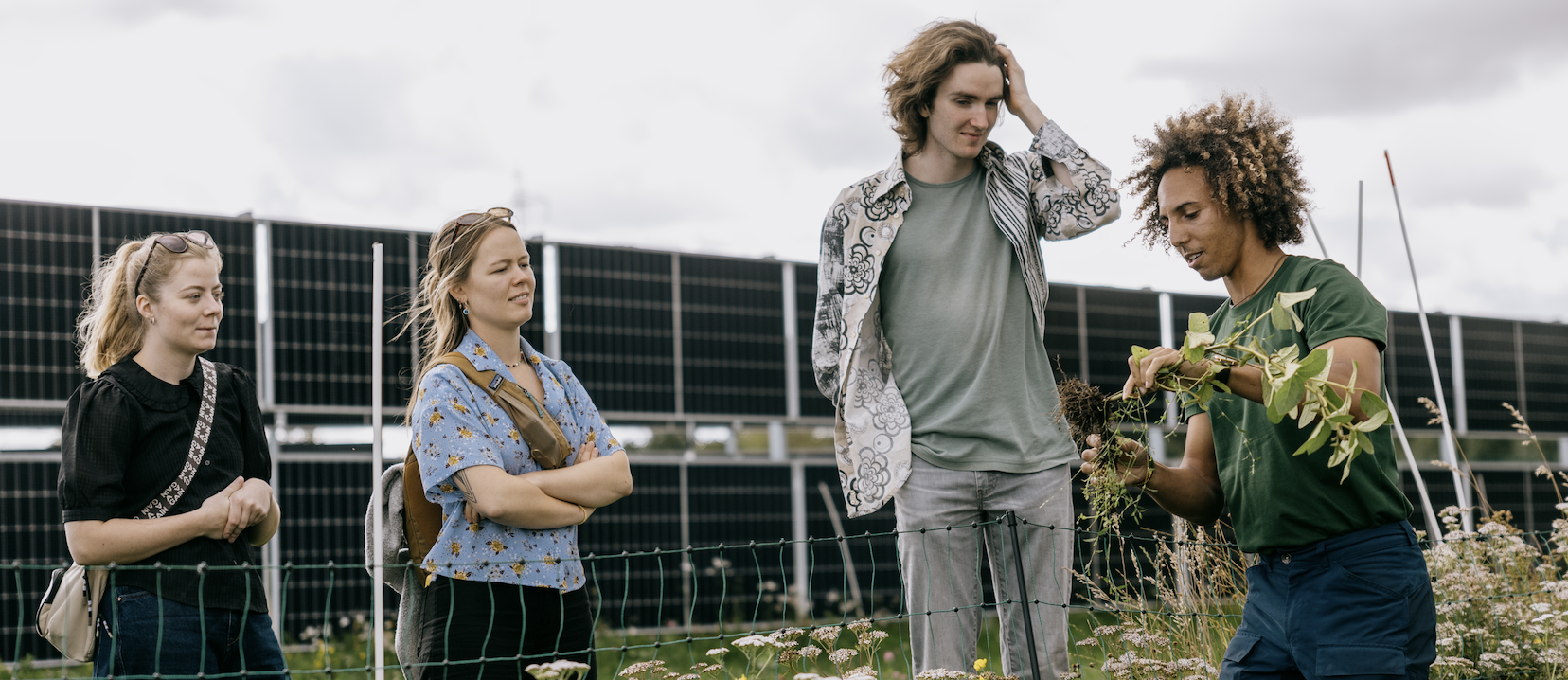
Ph.d.-uddannelser ved Institut for Agroøkologi
Agroøkologi beskæftiger sig med samspillet mellem jord, planter, dyr, mennesker og miljø i økosystemer til produktion af fødevarer, foder og biomasse. Vores formål er at uddanne og fremme den kommende generation af forskere, videnskabsfolk og udviklere af teknologi inden for agroøkologi og teknologi på højeste videnskabeligt niveau i et ægte tværdisciplinært og internationalt miljø.
Læs mere om, hvad vi kan tilbyde dig som ph.d.-studerende ved Institut for Agroøkologi og Aarhus Universitet her ved at klikke på emnerne nedenfor.
Guidelines
Guidelines
These guidelines are specific to AGRO and does not apply to PhD students outside AGRO.
PhD Supervision: Roles and Responsibilities in Practice
PhD Supervision: Roles and Responsibilities in Practice
Danish PhD legislation requires that the main supervisor is employed as associate professor (senior scientist) or above. The supervisors should have attended the supervision course offered by GSST.
The tasks of the supervisor can be summarized to:
Academic guidance
Help the student define the research topic to ensure it is original and feasible.
Assist in the formulation of research questions, hypotheses, and objectives.
Provide advice on appropriate theoretical frameworks, methodologies, and analytical techniques.
Ensure familiarity with key works in the field.
Encourage critical thinking and independence in research.
Project Planning and Management
Help the student develop a realistic research plan, including timelines and milestones.
Regularly monitor progress and provide constructive feedback.
Identify and manage potential risks or challenges in the research process.
Support the student in maintaining research ethics and integrity, including data management and plagiarism avoidance.
Research and Writing Support
Provide feedback on drafts of articles and conference papers.
Advise on publishing research outputs in journals or conferences.
Ensure the final thesis meets institutional and disciplinary standards.
Mentorship and Professional Development
Serve as a mentor, supporting both academic and personal development.
Encourage networking through conferences, seminars, and collaborations.
Offer career guidance, including postdoctoral opportunities, grant writing, and academic job applications.
Model professional and ethical behavior in research and academia.
Administrative and Institutional Responsibilities
Ensure compliance with university and funding body regulations.
Assist with progress reports, reviews, and examinations as required by the institution.
Help the student navigate administrative procedures, including ethics approval and submission processes.
Communication and Relationship Management
Establish a clear communication plan (meeting frequency, feedback expectations, etc.).
Provide timely, honest, and respectful feedback.
Address conflicts or misunderstandings constructively and promptly.
Welfare and Wellbeing Support
Be aware of the student’s mental health and workload balance.
Encourage healthy working habits and access to support services if needed.
Foster an inclusive, safe, and respectful research environment.
In case of tenure track researchers as de facto supervisors:
In the case that tenure track researchers or assistant professors are grant owners, they can act as de facto supervisors and have the role of daily responsible supervisor. The main supervisor and the tenure track should preferably be from the same section in AGRO. The PhD student should always be enrolled in the same section as the tenure track/de facto supervisor.
The formal main supervisor is responsible for administrative tasks in the MyPhD system (e.g., uploading bi-annual assessments), supporting the tenure track supervisor and acting as a support person in case of challenges.
We encourage the senior and tenure track supervisors to make early agreements to divide tasks and communication responsibilities for clarity for the PhD student. Here the following can be discussed:
Formulation of the supervisor agreement; it is advisable to describe the role of both main and de-facto supervisor (and potential co-supervisors)
Tasks and communication, e.g., how to involve the young scientist in the halfway evaluations. The young supervisor should make the assessments, but the main supervisor needs to add it to the MyPhD system
Agree on meeting participation with the PhD student; in many cases the de-facto supervisor can handle most activities
Discuss co-authorships (the formal main supervisor is not by default co-author in publications by the PhD student).
Agree on support in case of difficult issues.
It is possible to get up to 80,000 DKK from the department to cover supervision time, tuition fee or operational costs. This money will always be given to the tenure track, NOT the formal main supervisor.
The PhD Programme Chair can be contacted in cases where help is needed.
Timeline for PhD study
Timeline for PhD study
Overall formal structure
- Onboarding.
- Alignment of expectations
- 2.5 months – PhD plan to be uploaded and approved (latest after 3 months) in MyPhD.
- Qualifying exam halfway through your PhD.
- Handing in thesis – after 3 or 4 years (4+4).
- PhD defence ~2.5 months after handing in the thesis.
Every half-year
- Revisit student-supervisor alignment of expectations.
- Wellbeing conversations (held prior to half-year evaluation).
- 1 March and 1 September – half-year evaluation (update MyPhD).
Every autumn
- Staff Development Dialogue (SDD; Medarbejderudviklingssamtale, MUS, in Danish) with discussion on future career, held once a year with section manager.
- PhD day at the AGRO Researcher Days.
Recurring formal support
- Revisit “The good plan” for lab/field-based studies in collaboration with supervisor and TAP-supervisor.
- Join the Department’s weekly seminars where your colleagues present their work.
Building up your PhD plan
Building up your PhD plan
The PhD plan is the student’s responsibility. The plan is firstly discussed with your supervisors and then drafted by you and agreed upon with your supervisors. The final PhD plan must be submitted in myPhD no later than 2.5 months after starting your PhD study.
You must update your PhD plan two times a year in the online portal to keep it in line with your mandatory half year evaluation. It is possible to change parts of the plan throughout the study.
It is recommended to include a Gantt chart in your plan (with research tasks, publications, courses, research exchange, etc), as it helps you and your supervisors to see if you are on track. Ask your PhD buddy or supervisor for an example as inspiration.
Some parts of the plan should be put directly into myPhD:
- Courses
- Dissemination
- Conferences (eligible for ECTS)
- Change of environment
- Publications
- Duty work
- Supervisor agreement
You can find a template for a PhD plan in the box to the right.
Matching expectations
Matching expectations
Addressing any mismatches in mutual expectations early increases the chances of a good student-supervisor relationship and a successful completion of the PhD. Therefore, the Graduate School recommends simple tools to make the alignment of expectations between student and supervisor effective.
It is mandatory when making the PhD plan to upload a supervision agreement/alignment of expectations. AGRO suggest to formulate a Memorandum of Understanding. This can be done based on
- A supervision letter formulated by the supervisor
- Using Vote and compare as starting point for discussion expectations for the supervision.
Please note, that returning and adjusting the initial alignments of expectation is an important aspect of a good student-supervisor relationship throughout the entire PhD stude. This could be done in connection with the half year evaluation.
TAP collaboration
TAP collaboration
Good collaboration between supervisors, PhD student and TAP is very important.
Before working in the lab or the field, the supervisor must arrange a meeting between the supervisor, the PhD student and the TAP supervisor to discuss the collaboration and health and safety.
To help with this process we have created some documents to describe and plan the work:
- TAP supervisor expectations
- The good plan
The documents can be found in the Forms box to the right.
BUDDY function - job description
BUDDY function - job description
As part of our onboarding, the Department of Agroecology has an AGRO buddy programme to help all new employees adapt to our work culture and be acquainted with our workplace systems and processes. It is important for a new employee to have someone to talk to during the first weeks, to help ease the transition into their new job successfully.
Your work as a buddy is very important. As a buddy, you are expected to help new PhD students adapt to the new environment and to make sure that they become an integrated part of the research environment in the section and in the department. You should be available for assistance and act as a go-to person.
Expectations
As a buddy, you are expected to help the new student with the following:
- Remind the new students that they should be registered at the Kommune, open a bank account, and inform GSTS about CPR number.
- Layout of premises – for instance, direction to the canteen, coffee corners, toilets, etc.
- Introduction to other students and colleagues in the section/department.
- Invite and encourage the new student to come to relevant meetings (sometimes meetings in the calendars have been sent out before the person starts) (e.g., section meetings).
- Inform about social initiatives at the premises (gym, ping-pong, coffee breaks, bread and cake groups, Staff Club, social events, etc.).
- The bus transport schedule (bus times to and from the person’s place of residence if relevant) (www.rejseplanen.dk).
- Mention important websites:
- Department of Agroecology intranet http://agro.medarbejdere.au.dk/
- AU intranet https://medarbejdere.au.dk/en/
- GSTS PhD portal https://phd.tech.au.dk/for-phd-students
- Inform about departmental seminars.
- Inform about IT support opportunities.
- Inform about software that AU makes available.
- Inform about tools for alignment of expectations between supervisor and students .
- Help how to find relevant PhD courses.
- Introduction on how to book meeting rooms and cars in Outlook.
- Remind the new student to update their PURE profile with a picture and description of their project
- Introduction to MyPhD and show an example of a PhD plan.
- For new employees working in the lab or the field, inform about “The good plan”.
- Inform about the half-year evaluations due on/around 1 March and 1 September each year.
- Inform the new student about AGRO’s biannual wellbeing conversations between PhD student and PhD committee member. All students will have a conversation during the months prior to the half-year evaluation.
- Inform about the qualifying exam and show an example of the report.
- Mention of other relevant websites (listed below).
Be observant – is your new colleague happy?
Other relevant webpages:
- Software access: https://medarbejdere.au.dk/en/administration/it/buy-it-equipment-and-software/agreements-about-software
- AU Library: https://library.au.dk/en/
- Printer set-up: https://medarbejdere.au.dk/en/administration/it/guides/print
- Printer name: XXXX-XXXX-X-X on prtXX.uni.au.dk
- International Staff Office https://internationalstaff.au.dk/
- The Danish Agency for International Recruitment and Integration (SIRI) https://nyidanmark.dk/en-GB
- MitHR: https://medarbejdere.au.dk/en/administration/hr/hr-systems/mithr
- RejsUD: https://medarbejdere.au.dk/administration/oekonomi/afregning-af-udgifter-og-rejser/rejsud
- Accessing Outlook/network/drives/intranet/PURE (under “IT and Systems at AU): https://medarbejdere.au.dk/en/administration/hr/recruitmentandonboarding/newemployeeatau
- Accessing Eduroam: https://eduroam.au.dk/en/
- Staff Club AU Viborg: https://medarbejdere.au.dk/en/administration/overview-of-au-administration/administration-centre-nat-tech/for-medarbejdere-i-administrationscenter-nat-tech/personaleforening-for-administrationscenter-nat-tech/pffaudk/membership
- International Staff Club: https://internationalstaff.au.dk/uic
- Holiday Fund (summer cottages): https://feriefonden.au.dk
Well-being conversation
Well-being conversation
Twice a year (prior to the half-year evaluations in March and September), a member of the AGRO PhD committee will invite you to a “Well-being conversation”.
The purpose of the conversation is to offer you an opportunity to address any issue that is important to you. It could be issues which might not be easy to discuss with your supervisor, but which can have a profound impact on your well-being. This can be topics such as the progress of your PhD (at an overall level, not into the specific scientific topic) and how the cooperation with your supervisor and other staff is going. An important subject is also to take stock on your social wellbeing, both regarding work, work-life balance, or any other issues.
Examples of topics to discuss could be:
- General progress in your PhD
- Loneliness
- Collaboration with supervisors and other staff (PhD, researchers, employers)
- Stress
- Cultural or gender issues
- Offensive behaviour
- Ideas for improvements (personally or for all students in AGRO)
- Ideas for improvements in furniture and physical wellbeing
- Ideas for student events
- Any subject which is important for you at the time of conversation
The talks are mandatory and confidential, and no minutes are made. If needed, a plan for improvement of your wellbeing will be made by you and the PhD committee member. No action is taken unless agreed with you.
The conversations typically last between ½-1 hour.
You are welcome to contact your well-being-person at any time.
PhD seminar (startup) and feedback
PhD seminar (startup) and feedback
The PhD seminar takes place within the first half-year after you start your PhD studies. The seminar will be held physically with the possibility for online streaming.
The seminar is booked by the PhD secretary.
The seminar lasts a total of 30 minutes, including questions and feedback. The presentation itself should take between 15 and 20 minutes.
The purpose of the presentation is to introduce your project to your colleagues, give an overview of the planned activities and receive valuable feedback at an early stage in your PhD. You can use your initial PhD plan as a guide when structuring your seminar.
The presentation should have two parts. In the first part, you should focus on the scientific background and hypotheses you will address in your PhD studies. The second part should focus on your plans such as publications, change of work environment, courses taken, etc., to fulfil the PhD requirements.
Your main supervisor will briefly introduce you at the beginning of the seminar. In case your main supervisor is not available, then the task is transferred to a member of the PhD Committee.
After your presentation, there will be a short feedback session, where the audience offers comments and poses questions on the proposed PhD plan and structure and advise you if certain aspects seem irregular or even unfeasible. Fellow PhD students are encouraged to give you relevant feedback, both in connection to your topic, but also more general feedback on your presentation technique, etc.
Half-year evaluation
Half-year evaluation
Two times a year, you should write an assessment of your progress during the last half-year and describe your plans for the next half-year. In AGRO, the half-year evaluations should be finalized by 1st March and 1st September.
For the PhD student:
The mandatory half year evaluations state whether the research project and study in general are progressing in accordance with the PhD plan.
The submission and approval of half year evaluations are handled electronically as part of the online myPhD by the involved parties (PhD student, Main supervisor, Head of programme and Head of PhD School).
- If you started your PhD study in Jun, July, August, September, October or November, you should submit your first half-year evaluation by March 1.
- If you started in December, January, February, March, April or May, you should submit your first half-year evaluation by 1st September.
The dates stated in myPhD should not be followed.
An evaluation is not required if:
- the PhD plan is still under approval;
- you are on sick leave;
- you are on parental leave;
- you are at the end of your PhD and have closed myPhD as part of finishing your study.
If your PhD plan has just been approved, you need to make a brief evaluation anyway. It should contain a short description of your progress so far and your current plans.
Remember to re-visit your PhD Plan (the pdf file with the description of the scientific content of your PhD), and make sure that it is updated. In case of substantial changes, upload a new document.
Before you start writing your assessment in myPhD you need to tick one of the three options:
- Expect plan will lead to timely completion
- Concerned plan may not lead to timely completion, adjustments necessary
- Expect plan will NOT lead to timely completion, 3 months trial period necessary
Your assessment (corresponding to ½-1 A4 page) should be made directly in the dialogue boxes in myPhD. What you write in the dialogue box will be saved in myPhD as a record of your progress. Ask your supervisor or PhD buddy if you are in doubt.
The assessment should contain information regarding your progress during the last 6 months on:
- scientific work
- publications
- courses
- dissemination
- duty work
- teaching
- change of environment
- reflections on your growth as an independent researcher.
Please also update specific details on courses, change of environment, conferences etc. directly in myPhD.
This is also a good time to update/revisit your Alignment of Expectations document. If changed, note it in the dialogue box.
It is important to state whether things are progressing as planned and if not, state the reason(s) why.
When the half-year evaluation is completed, you should click “Send to supervisor”. When the assessment is sent to the supervisor a dialog box opens in which the supervisor will make their assessment of your progress. They also need to tick off one of the three options described above. When your supervisor has made the assessment the system locks, but you will be able to comment on the assessment made by your supervisor. Finally, both head of programme and head of school will make a final assessment of your work. You need to enter the system and check whether Head of programme or head of school has made comments on your progress. You can see these comments in the plan history.
If you are in doubt about which option to choose, please contact your supervisor or Head of Programme.
If you update in your PhD plan outside of the half-year evaluation rolls, the plan should only be saved and not sent for evaluation.
For the Supervisor:
It is important that you make a thorough assessment (i.e., approximately ½ A4 page of text). Once you have gone over your student’s PhD Plan and evaluation, there are two options. If the evaluation is ready to be passed on in the workflow, click the “Complete assessment. Send to student” button at the bottom of the page. This sends the evaluation back to the student for comments before it is passed on to the Head of Programme. If, the student needs to do further work, before it is ready to be passed on in the workflow, you should click the “Return to student for plan adjustments” button. The evaluation is returned to the student for further work, before it is once again passed on to the supervisor for assessment and final acceptance, to the Head of Programme and finally, to the Head of School
When the evaluation has been approved by the Head of Programme and the Head of School, the myPhD status will change to “awaits student planning”.
The evaluation and previous evaluations can be found in “Plan history”.
Ad hoc courses
Ad hoc courses
Supervisors have the option to define and develop an ad hoc course designed specifically for their PhD student. Such a course could include e.g. lectures by the supervisor or another scientist, a short internship with a company, specific instrument training in a foreign lab, journal club or other things. A course description (see below) must be prepared, and the supervisor is, as a rule, the course responsible. The ad hoc course must be pre-approved by the Head of Programme. When the course is completed, the student/supervisor sends an E-mail to the Head of Programme (lis.w.de.jonge@agro.au.dk) with the following attachments: course description; statement from the course responsible with an assessment of the outcome of the course in relation to the student’s development.
The ad hoc course description must include description of the following elements
Name of course:
Suggested ECTS credits:
Course parameters:
No. of contact hours and hours in total:
Capacity limits: ad hoc course, no capacity limit.
Objectives of the course:
The objectives of the course are to:
Learning outcomes and competences:
At the end of the course, the student should be able to:
Compulsory programme:
The students must deliver:
Course contents:
Literature:
Course assessment:
Approval of PhD courses
Approval of PhD courses
See form in the box to the right
ECTS points for conference participation and other activities
ECTS points for conference participation and other activities
The Danish rules on PhD studies allow PhD students to obtain ECTS points for conference participation. According to GSTS guidelines a maximum of 10 ECTS can be obtained for activities which are not ordinary formal PhD courses. Some activities (e.g. lectures by the supervisor or another scientist, a short internship with a company, specific instrument training in a foreign lab) can be handled as ad hoc courses where the student must describe the activity in a PhD course template with clear learning goals, and the local PhD program chair must approve it.
Prior to the conference or activity, the student and the main supervisor must discuss the expected outcome of the participation.
The student must describe the activity in the template found in the Forms box to the right, and the PhD program chair must approve it.
The requirements and procedure for approval of ECTS for conference participation or other activities are as follows:
- Relevant scientific topic
- Agree on clearly formulated learning goals for the participation, such as:
- Prepare oral or poster presentations
- Prepare questions for specific, relevant lecturers
- Actively approach relevant researchers to start a network or cooperation
- Prepare for relevant lectures by reading the latest publications about the topic
- Write a one-page report
- Make a presentation in the section where the student is working
A student may obtain a maximum of 5 ECTS in the total course portfolio for conference participation
ECTS for each conference are equivalent to
- a maximum of 1 ECTS for participation without presentation
- a maximum of 2 ECTS for participation with oral or poster presentation
One ECTS point corresponds to 25-30 hours of work.
Template for ECTS approval can be found in the Forms Box to the right.
Work Obligations for PhD Students - Duty work
Work Obligations for PhD Students - Duty work
As a PhD student, your employment includes tasks other than the PhD project. These can amount to a maximum of 280 hours per year or 840 hours over the course of your PhD, as set out in the “Cirkulære om overenskomst for Akademikere i staten and GSTS Rules and Regulations.
AGRO does not count these hours, but the department is entitled to assign tasks to a student; often it is handled by your main supervisor and/or the programme chair.
You may report the extent of duty work in myPhD (you do not need to count hours) and it should be updated at each half-year evaluation (specified according to the type of work, e.g., name of course, type(s) of communication/presentation). It should also be discussed with your main supervisor. We urge you to keep a record of your work.
All dissemination activities (including lectures) are listed in myPhD under “Dissemination”. Any other kind of duty work must be reported under “Other Activity” or a bullet created by you called “Duty work”.
Examples of duty work can be:
- lectures for bachelor, graduate or master students
- lectures for PhD courses
- dissemination to school students
- supervision of bachelor or graduate students
- article reviews
- experiments not part of the project
- articles not part of the dissertation
- planning of conferences, theme days, meetings, etc.
- committee work
- tasks related to policy support
- guided tours for guests
- organisation of seminars and journal clubs
- buddying for new PhD students.
Discussion of duty work ought to be on the agenda for your supervisor meetings. Coordinate the expectations of duty work, especially at the first supervisor meeting and in connection with preparation of the PhD plan.
Students in AGRO's PhD committee
Students in AGRO's PhD committee
Students are expected to:
- Attend PhD committee meetings and contribute on more general matters. There are approximately 3-4 meetings per year (about two hours per meeting).
- Work as a link between other PhD students and Lis, Karina and the other PhD committee members.
- Raise topics at the PhD committee meeting, for example, if something does not work as expected or is really good.
- Discuss/plan a "Student event" once a year. The main purpose is to strengthen the social PhD network, but it should also contain a professional part. Topics could be:
- stress management
- well-being.
It is possible to apply GSTS for 5,000 DKK per year per location to host a social event for PhD students.
What do students get out of it?
- Influence on issues to be addressed and decisions to be made.
- Participation counts as part of duty work.
Appointment process
Students are members of the PhD committee for one year. Around October, the current student members will call a meeting with all PhD students in AGRO and inform everyone about the possibility of becoming committee member for the following year. One student from Flakkebjerg should be appointed and four students in Foulum/Aarhus (from different sections). If possible, students in their second year of study should be appointed. Diversity is taken into consideration when appointing representatives.
One of the appointed students should sign up for the election to the GSTS PhD committee.
PhD travels
PhD travels
Please be aware that there are special rules for PhD travels, so always check with the PhD secretary about the rules for travelling when you plan your trip.
Travels of up to 10 days (conference/congress/course/project meetings)
In AGRO, it has been decided that the PhD students receive the standard daily allowance in connection with trips of up to 10 days (both in Denmark and abroad). The daily allowance covers additional expenses for meals, small items, local transport at the destination, etc., paid by the student during the travel. This means that the company Eurocard should not be used during the travel. If free meals are received, they should be deducted when making the travel statement in RejsUd.
Additionally, the following will be covered (often via Eurocard before the travel is made):
- transportation to and from the main destination (cheapest public transportation)1
- accommodation2
- visas
- conference/congress/course fees (including mandatory events paid together with the fee)
These rules also apply for enrolled PhD students without salary from AU.
Change of environment*
In relation to the PhD change of environment, the following will be covered:
- transportation to and from destination (cheapest public transportation)1
- visas
- documented, reasonable and necessary set-up costs (e.g. bed, chair, table, basic kitchenware)
- Bench fee, if necessary to carry out the change of environment.
Please note the following:
- PhD students can apply for a GSTS mobilty grant
- if conferences/congresses are attended elsewhere during the change of environment, the above “Stays of up to 10 days” must be implemented.
- courses, regardless of length, are excluded from this category and run with the above description (“Stays of up to 10 days”).
All reimbursements related to change of environment should be sent to Karina Rysholt Christensen. If it is related to the mobility grant from GSTS you should make the settlement in RejsUD yourself.
All costs, mentioned above in connection with the travels are paid from the PhD project and should therefore be made in agreement with your supervisor. Only the abovementioned costs can be paid, and we cannot cover costs for the PhD student’s family.
1Information about flights can be found here.
2Information about hotels can be found here.
*It is important to contact SKAT in good time before going abroad (at least 1 month before) as it may be possible to get a tax deduction in connection with the stay abroad. It can be very individual, so it is best to contact SKAT directly on 72 22 28 28. More information can be found on SKAT’s homepage.
You can find more information about going abroad at GSTS’s webite
The qualifying exam
The qualifying exam
The qualifying exam is held halfway through your study. It consists of a written report and an oral presentation of your progress and plans.
It is evaluated by your supervisor(s), one internal and one external opponent.
The purposes of the qualifying exam are:
- to give the PhD-student a chance to conclude current work and get others’ opinions and advice on progress and how to best proceed.
- to give the supervisor(s) a chance – if not done before – to initiate talks on the eventual content of the PhD thesis and how to get there.
- to allow the PhD school to ensure that the student accomplishes their study as planned, and to discuss and validate plans for the rest of the study period.
The qualifying exam takes the form of a seminar and then a discussion where you, your supervisor(s) and the opponents evaluate what has been done so far and highlight priorities for the remaining part of your study. It should therefore be seen as an opportunity to plan the rest of your scientific programme and time schedule, as well as the formalities for finalizing your PhD thesis and conducting the defence.
The exam usually takes place 18 months before submission of the thesis (or after 24 months if you are a 4+4 student). More information can be found here: https://phd.tech.au.dk/for-phd-students/progress-report-qualifying-exam
Overview of the process:
- Approximately 3 months prior to the qualifying exam, the PhD student receives an email from the PhD school describing the formal requirements of the exam.
- Six weeks prior to the exam, the PhD-student needs to register according to the email from GSTS.
- Three weeks prior to the exam, the PhD-student should submit a progress report of up to 30 pages, where the student briefly introduces the field of research, gives the aim of the PhD-study, gives an overview of the planned work, gives details on accomplished work (we strongly advise to use draft manuscripts directly), gives an overview of status on coursework, change of environment and duty work, and gives a detailed plan for the remaining study period.
- At the qualifying exam, the PhD-student first gives a presentation (up to 45 minutes) and secondly discusses the status and progress with the two opponents and the supervisor(s).
Responsibilities of the Supervisor:
- Identifying the external examiner
- in-person attendance
- accomodation is not covered
- Coordination with the internal and external examiner – when to meet etc.
- Arrange coffee / lunch etc. for the external examiner
- Booking of meeting room for evaluation after the presentation
Expenditures in connecton with qualifying exams
Expenses for the qualifying examination are equivalent to expenses for the specialised examination and are covered by the departments in accordance with the financial model as of 1 January 2019.
Lunch and any accommodation in connection with the qualification examination are not covered by the PhD school, but the department may choose to pay for lunch amd accommodation in this connection. This must be approved in advance by the head of the secretariat/head of department.
PhD thesis requirements
PhD thesis requirements
Requirements
AGRO recommends that the PhD thesis is based on at least three full-length manuscripts that have either already been published or are publishable in internationally-recognized, peer-reviewed journals. The PhD thesis typically includes sections encompassing the following elements.
- Preface.
- Acknowledgements.
- Table of contents.
- Summary in English.
- Summary in Danish.
- A general introduction describing the academic field of study, including references to existing knowledge along with the purpose/aim of the project and a brief description of the proposed research questions and/or hypotheses.
- A description of materials and methods, and an assessment/discussion of the applied methodologies.
- A summary of main results, potentially also representing parts that are not included in the attached articles/manuscripts, but still has scientific merit in relation to the PhD topic.
- A discussion section in which the PhD student relates the entirety of their own work and results to the state-of-the-art within the field. The PhD student must demonstrate an up-to-date knowledge hereof and be able to put this knowledge into a broader perspective. The discussion section should demonstrate the student’s ability to find, synthesize and critically evaluate information from various sources. The section should also document skills in terms of paraphrasing and citation.
- Conclusion(s) and future research perspectives.
- References.
- Published articles and/or submitted or draft manuscripts.
If published articles or submitted manuscripts are included in the thesis, you must ensure that you have permission from the publisher to reproduce these in the thesis, if necessary (i.e., if not published open access under a Creative Commons license). The procedure for obtaining permission depends on the publisher and can be found via the journal’s webpage.
Printing of the thesis
It is your responsibility as a student to contact Karina Rysholt Christensen (kch@agro.au.dk) if you want printed copies of your thesis. Please note that if you do not contact Karina or keep the deadlines mentioned below, the thesis will NOT be printed. Find more information in the "how-to-guide" that GSTS has made.
In order to have the thesis printed, the following should be sent to Karina no later than 1 month before the defence:
- Declaration stating that we are allowed to print the thesis.
- Pictures for cover page (3 pictures of high quality). Karina can assist with ideas for the cover page if needed.
- Title of the thesis.
- Short summary for the back page (maximum 650 characters including spacing).
No later than 14 days before the defence, the following should be sent to Karina:
- Final thesis in pdf version.
- List of pages to be printed in colour (page numbers of the pdf-file, not as per the list/table of contents).
- Information about where the thesis should be sent (Foulum or Flakkebjerg).
The official font at AU is AU Passata or Georgia and the size should be 11, with 1.5 line-spacing. Headers should be size 12 and bold.
The first page of the contents should be on a right-side page when the thesis is opened.
The page numbers are centered, 10 mm from the bottom of the page.
Margins: top = 25 mm; sides = 25 mm; bottom = 20 mm.
The department will pay for 25 printed copies. Of these, two copies must be sent to the library and two copies must be kept in the department. The student will have the rest of the copies.
All contact to the printing company will go through Karina Rysholt Christensen (kch@agro.au.dk).
Online publishing through E-books platform
If you are interested in publishing your PhD thesis or other material, the Royal Danish Library in Aarhus offers an online publication service through their E-books platform. This service will enable you to provide Open Access to your research and still maintain author’s rights for your PhD thesis.
The content is visible in catalogues worldwide, including library.au.dk. The service is free. Backup of the material is provided, and online help is available.
For more information, please have a look here: http://ebooks.au.dk/index.php/aul/index
Who Does What in Connection with the PhD Thesis & Defence?
Who Does What in Connection with the PhD Thesis & Defence?
PhD student
- Check that all PhD courses are approved by GSTS.
- Check that you have permission from the publisher to reproduce articles and manuscripts (check the journals’ homepages).
- Submit required forms and information (mentioned in mail “Upcoming PhD dissertation” from GSTS) to the PhD school along with the PhD thesis.
- Contact Charlotte Hamann Knudsen in due time if you want to have your thesis printed.
- Check that computer and audio/video equipment is working correctly.
- Check that the presentation works on the computer in the lecture hall prior to the defence. Agree with IT for them to be on standby on the day, if necessary.
Supervisor
- Check with Karina Rysholt for internal opponent and planned time. The defence should always take place 2½-3 months after the submission of the thesis. The date should always be checked with the internal opponent before contacting the external members. Make sure the assessment committee is appointed and approved by Lis Wollesen de Jonge.
- Complete supervisor statement and send to GSTS at the time of submission.
- Assist with travel arrangement for members of the assessment committee. As a rule, the external members book the travel themselves (section secretary can assist in very special cases; GSTS will book accommodation if needed).
- The PhD student’s section coordinator can help with practicalities, e.g. booking meeting rooms, ordering lunch, coffee, and water to the external examiners and cleaning up after the defence, but it is the supervisors responsibility to ask.
- Announce the defence for partners and collaborators.
Chair of assessment committee
- Manage the assessment of the PhD thesis together with the external opponents.
- Submit recommendation form to GSTS.
- Chair the defence session.
- Convene the necessary meetings with the assessment committee before and after the session
- Submit the final recommendation form to GSTS.
PhD secretary Karina Rysholt Christensen
- Send link to this checklist to PhD student and supervisor and send link to guidelines regarding thesis to the student.
- Announce the defence in the department and book the lecture hall
- Order reception in Foulum. In Aarhus and Flakkebjerg it is done locally
Charlotte Hamann Knudsen
- Make suggestions for lay-out of cover of PhD thesis.
- Obtain ISBN number and send thesis to the printers.
Expenditures in connection with the PhD defence
The Graduate School of Technical Sciences covers a number of expenses
associated with holding PhD defences. These are described in a memo dated 8 October 2024.
PhD courses
PhD courses
AGRO's own courses
2026
February 3-13: Biostatistics Modelling (5 ECTS). Responsible: Franca Giannini-Kurina and Maarit Mäenpää
Costs: 300 Euro. Sign-up here: Biostatistical modelling for Ag. Science 2026 - Laravel (Deadline: 16 January '26)
April - June (specifically Day 1-2 on April 28-29, and Day 4-5 on June 22-23. In between we expect you to attend hands-on demonstrations): Isotopes for nutrient, organic matter cycling and plant-microbial interaction studies – theory and applications (5 ECTS). Responsible: Kirsten Lønne Enggrob, Leanne Peixoto, and Jim Rasmussen
Course fee: 300 Euro. sign-up here (Deadline: 01 February 2026).
May 18-22: Root Methods (5 ECTS). Responsible: Eusun Han
Course fee: 620 Euro, sign-up here (Deadline: 17 April 2026)
June 8-19: Hands-on Liquid Chromatography–Mass spectrometry course in the analysis of small molecules (phytochemicals, contaminants, primary metabolites) (8 ECTS). Responsible: Benjamin Fuchs.
Course fee: 3500 Euro (incl. lunch, dinner, transport and accommodation for 12 nights) or 1900 Euro (without accommodation). Sign-up here (Deadline: 01 May 2026)
June 15-20: Merging Measurements and Modelling in Soil Physics (5 ECTS). Responsible: Trine Nørgaard & Lis Wollesen de Jonge.
Course fee: 620 Euro, sign-up here (Deadline: 31 May 2026)
October 26-30: Assembly and functioning of crop microbiomes (5 ECTS). Responsible: Mogens Nicolaisen
Course fee: 1200 Euro (incl. accommodation) or 600 Euro (without accommodation). Sign-up here (Deadline: 01 September 2026)
November 2-6: Agroecology and agri-food system transition (5ECTS). Responsible: Martin Thorsøe and Torsten Rødel Berg
Course fee: 600 Euro, sign-up here (Deadline 01 October 2026)
November 8-13: Nitrogen in agroecosystems: from microbial transformations to global budgets (5 ECTS). Responsible: Diego Abalos
Course fee: 620 Euro, sign-up here (Deadline: 25 October 2026)
GSTS and other relevant courses
Internal journal clubs
Internal journal clubs
You can claim ECTS for regular attendance at a journal club. Currently running clubs are:
Journal Club 2025 at AU Viborg - for information please contact Christian Dold
Journal Club, Flakkebjerg - for information please contact Liza Martinez
_________________________________________________________________________________________________________
If you are a group of students that are interested in establishing journal clubs, you can get ECTS point for doing so. Here are some examples on previous journal clubs:
Climate and water and Soil fertility sections journal club
PhD Committee - 2025
PhD Committee - 2025
Wellbeing initiatives in AGRO
Wellbeing initiatives in AGRO
The wellbeing of all members of staff in AGRO is very important, but we have several initiatives related specifically to PhD students and junior scientists. These initiatives have been established and improved over the years as we find it very important to support especially our young people the best way we can. Many of the initiatives are very unique and only offered at AGRO.
Buddy-scheme
AGRO’s buddy-scheme was established in 2007 on requirement from the PhD students. The list of tasks was made by the students, and it is continuously updated to reflect the needs of the current students. In 2016 the buddy-scheme was introduced to the entire department as part of our onboarding programme.
The purpose of the buddy-scheme is to make new students feel welcome and to make sure that they become a part of the scientific and social part of the department.
Introduction meetings for new students
4 times a year we will in continuation of the department introduction meetings have specific introduction meetings for new PhD students in the department. The meeting will contain information on our specific PhD initiatives and other things to be aware of in connection with doing a PhD in our department.
Wellbeing conversations
Wellbeing conversations were implemented in 2015 and have since been part of the PhD committee’s tasks. The conversations are held twice a year between one of the senior PhD committee members and the student.
The purpose of the conversations is to give the student a room to discuss topics with a person who is not involved in the PhD project. The student sets the agenda and decides which topics should be discussed.
It is mandatory to participate in the talks, they are confidential, and no minutes are taken. It is possible to book more conversations if it is needed.
AGRO (Researcher) Days
Once a year a two-day event for all VIP and PhDs in the department takes place. The days can be used to discuss relevant topics both together (VIP and PhDs) and in relevant groups.
It is a possibility to get together across the sections and locations and it is great opportunity to discuss things that are relevant for both VIP and PhD.
The PhD committee gives suggestions to the topics that should be treated at the meeting.
PhD committee workday
Once a year the PhD committee meets for a physical meeting. At this meeting all guidelines and descriptions on the PhD homepage are being evaluated and updated. At this event the students have the possibility to influence the way things are done and described and we make sure that the guidelines, processes, and descriptions reflect the current PhD students’ needs.
Introduction meetings
Introduction meetings
4 times a year the department will have introduction meetings for all new employees and guests in the department. These meetings will contain general information about the department and being a member of staff at AU. The meetings will be held online so all locations can follow the same meeting.
The PhD committee will host an extended introduction meeting for the new PhD students after the general introduction meeting. This meeting will focus on the things that are special and unique to being a PhD student.
The content of the meeting will primarily contain information on:
- The PhD committee (AGRO+GSTS)
- Buddy function
- TAP-supervisor and The good plan
- PhD plan and MyPhD
- ½ year evaluation
- Well-being conversations
- Courses, seminars, change of environment and dutywork
- Alignment of expectations
The meetings will be held online to ensure high participation